
Ancient Babylonia had a thriving trade system with neighboring areas.
Trade was critical to Old Babylonia, where many highly prized natural resources were scarce but agricultural goods were in surplus. A vibrant trading system developed, bringing manufactured goods and raw materials from as far as Turkey, and even India, 1500 miles away. Trade became integral to the economy and the culture. In this lesson, students explore the trade industry in Old Babylonia and its far-flung influence.
What connections existed between trade and the economic, cultural, and religious life of Old Babylonia?
The Old Babylonian period in Mesopotamia lasted from about 2000 BCE to 1600 BCE. By about 1760 BCE, most of Mesopotamia was brought under Babylonian rule, largely through the conquests of Hammurabi, the sixth king in Babylon's First Dynasty. A famous and important source of information about life in Old Babylonia is the so-called "Code of Hammurabi" which indicates the importance of class divisions, family life, religion, and commerce. For more on life in Old Babylonia, see the complementary EDSITEment lesson Hammurabi's Code: What Does it Tell Us about Old Babylonia?
In this activity, students refer to a natural resource map of the region to learn the source of materials for Old Babylonian artifacts reviewed online.
Mesopotamia, a hot, dry region subject to floods, became fertile enough to produce a surplus of grain thanks largely to a system of canals first built perhaps a thousand years before the Old Babylonian period. In this way, agricultural products became available for trade. In general however, Old Babylonia had a dearth of natural resources. Ceramic bowls and figurines as well as bricks for buildings, were produced locally from clay. But clay was found throughout the Middle East. Bitumen, a naturally occurring residue from underground oil deposits used in construction and to waterproof boats, was one of the only other important natural resources in Old Babylonia. But artifacts recovered from the period often feature materials (such as gold) not readily found in Mesopotamia.
The Natural Resources Map, from the "Mesopotamia" site at the British Musuem, available through a link from The Oriental Institute: The University of Chicago, shows where many source of materials were located in the Middle East and beyond. Because some of the materials may be unfamiliar to your students, an explanation entitled Some Natural Resources Used in Old Babylonia is available in the downloadable PDF documents for this lesson. All online maps referred to in this lesson are accessible through a link from the EDSITEment-reviewed web resource The Oriental Institute: The University of Chicago, unless otherwise noted.
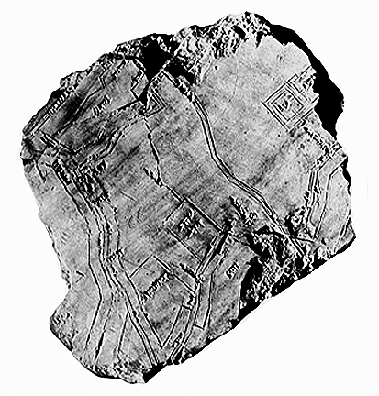
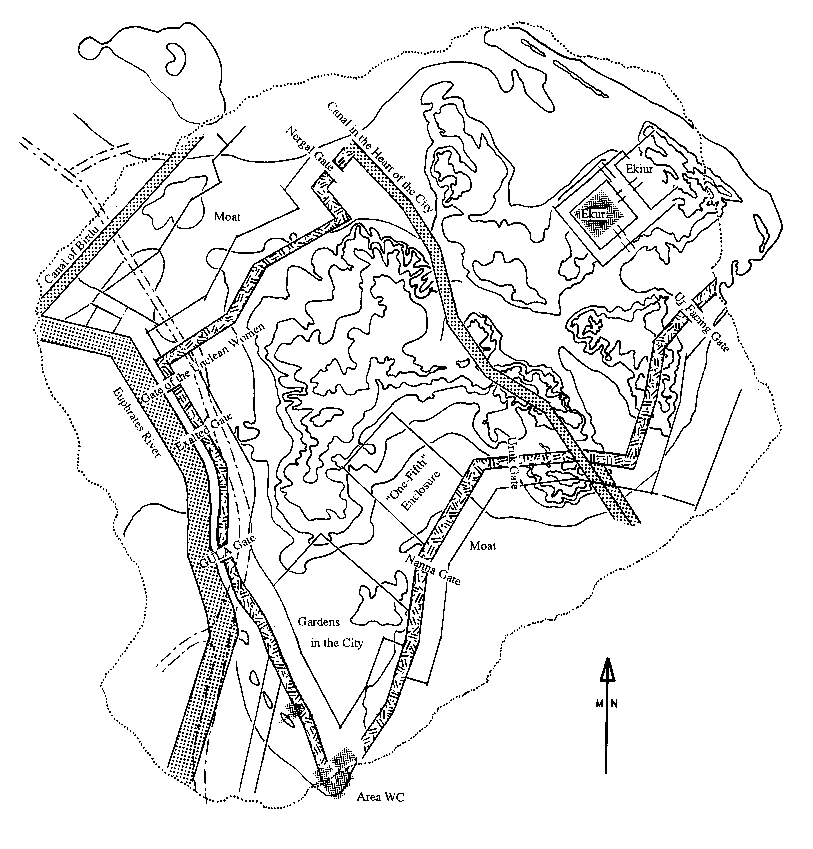
Nippur, a principal religious center throughout the history of Mesopotamia, was the sacred city of the god Enlil, chief god in the Sumerian and Akkadian pantheon. Even after the Babylonians, through the expansion of their empire, made their chief god Marduk head of the pantheon, leaders still sent tribute to Nippur. In this activity students will use an ancient map of the city of Nippur to learn more about the impact of trade in Old Babylonia.
An ancient map of Nippur, available as an Interactive Map of Nippur from the PBS site, through the EDSITEment-reviewed Internet Public Library, reveals the impressive size (and presumably, the importance) of the religious center in Nippur as well as the infrastructure (such as docks and canals) of an important economic center. The Kassites, who were an important force in the region from the 16th to the 12th centuries BCE, took up residence in Nippur centuries after the city was abandoned, and created the ancient map of Nippur. Though the map was inscribed long after the demise of Old Babylonia, archaeological evidence has proven it remarkably accurate in showing the city as it was in Old Babylonia. The Kassites built their new city on the remains of the old.
Note: Teachers of classes unable to use the Interactive Map of Nippur can use the Overlay of Ancient Nippur Map on Modern Topographic Plan of Site from The Oriental Institute: The University of Chicago. It shows the ancient Nippur map superimposed on a modern topographic archaeological plan of the site. This map may also be of interest to individuals in classes with online capabilities.
Now that students have viewed some evidence in the archaeological record showing that trade was important in Old Babylonia, they will explore the impact of trade on Old Babylonia. Through an historically accurate but hypothetical interactive web activity structured as a choose-your-own adventure story, students will join a merchant on a journey to trade goods in a foreign city.
Trade touched virtually every aspect of life in Old Babylonia (ca. 2000 BCE-1600 BCE). Industries critical to trade--boat building, for example—flourished. Kings supported trade by developing an infrastructure (such as docks and canals) too expensive or complex to be built by any other entity in Old Babylonia. Kings were in turn supported through customs levies and the influx of materials such as bronze. While on extended journeys, traders made pilgrimages to religious shrines, which became important economic centers. Wealthy kings also paid offerings to religious centers. Not every trader journey was an extended one, however, and some goods passed through numerous hands on much shorter journeys before reaching their destination. In addition to commercial imports, traders brought back to Babylonia cultural items and ideas from distant lands, and these ideas had an impact on the development of Babylonian culture. The cultural meaning of many of these items was likely affected by the method of trade that brought the objects to Babylonia, such as whether or not it arrived with people by whom it was made, gathered, or harvested, or whether it arrived through a series of middle men.
Note: Dilmun, likely the present day island nation Bahrain, was a critical crossroads on the trade routes between Mesopotamia and the Indus Valley of present day Pakistan and northern India.
Students should look for incidents in the story such as those in which:
Ask students to write a brief essay about the importance of trade in Old Babylonia. Their essay should concentrate on one of the following questions:
Students should think about the following issues while writing their essays:
They should use all of the information that they have gathered while completing this lesson, and use examples from what they have read in their essays.
2-3 class periods