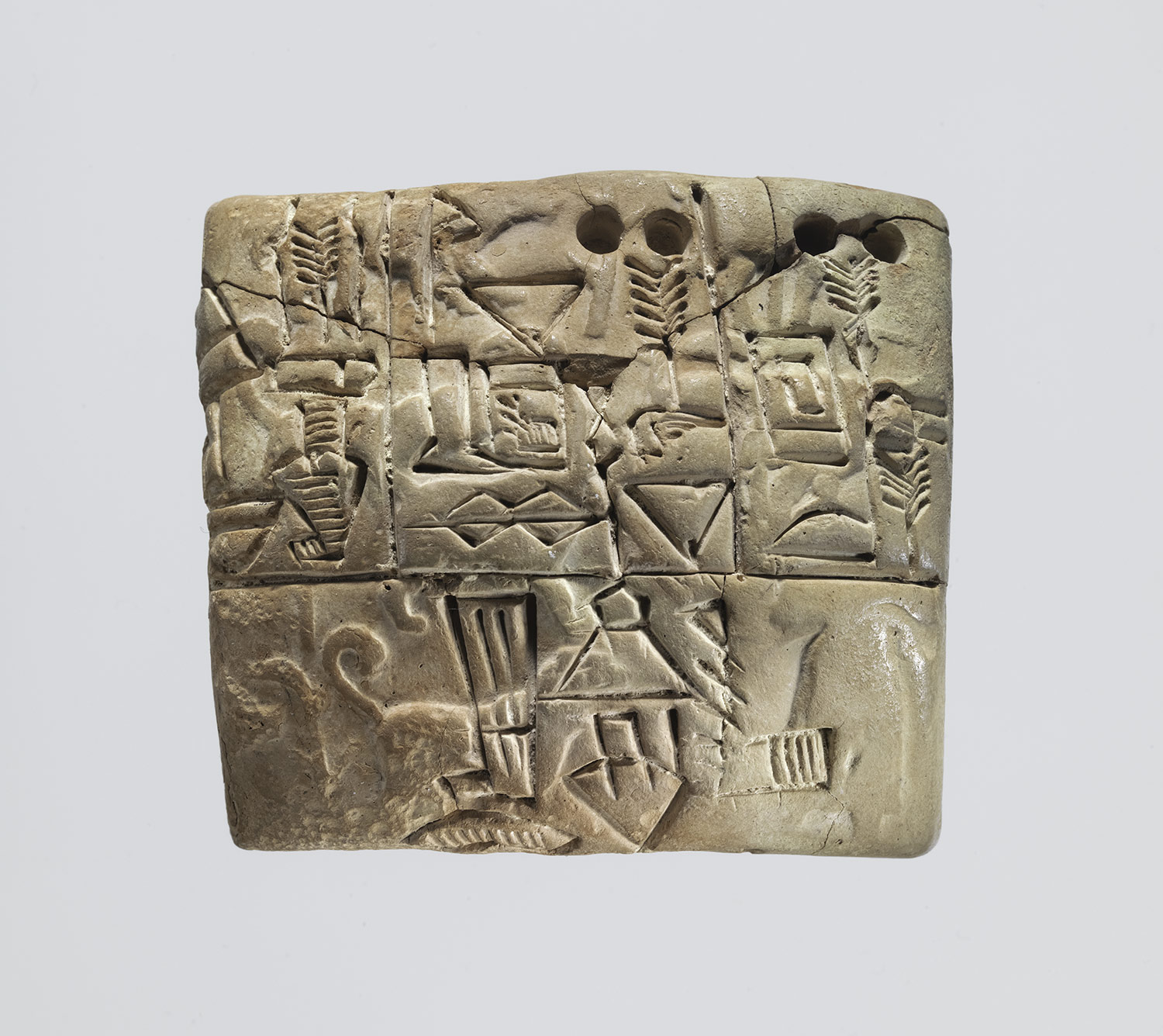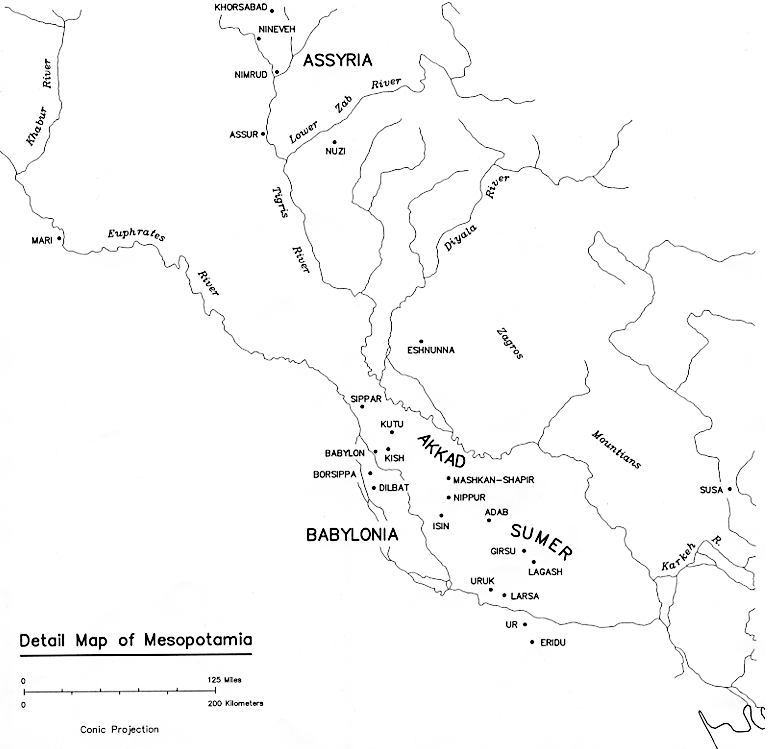

The Mesopotamian basin was the birthplace of writing. The Cuneiform writing system developed here was the first form of communication beyond the use of pictograms.
The earliest writing systems evolved independently and at roughly the same time in Egypt and Mesopotamia, but current scholarship suggests that Mesopotamia’s writing appeared first. That writing system, invented by the Sumerians, emerged in Mesopotamia around 3500 BCE. At first, this writing was representational: a bull might be represented by a picture of a bull, and a pictograph of barley signified the word barley. Though writing began as pictures, this system was inconvenient for conveying anything other than simple nouns, and it became increasingly abstract as it evolved to encompass more abstract concepts, eventually taking form in the world’s earliest writing: cuneiform. An increasingly complex civilization encouraged the development of an increasingly sophisticated form of writing. Cuneiform came to function both phonetically (representing a sound) and semantically (representing a meaning such as an object or concept) rather than only representing objects directly as a picture.
This lesson plan, intended for use in the teaching of world history in the middle grades, is designed to help students appreciate the parallel development and increasing complexity of writing and civilization in the Tigris and Euphrates valleys in ancient Mesopotamia. You may wish to use this lesson independently as an introduction to Mesopotamian civilization, or as an entry point into the study of Sumerian and Babylonian history and culture.
The earliest known civilization developed along the Tigris and Euphrates Rivers in what is now the country of Iraq. The development of successful agriculture, which relied on the region’s fertile soils and an irrigation system that took advantage of its consistent water supply, led to the development of the world’s first cities. The development of stable agriculture through irrigation meant people no longer had to follow changing sources of food. With this stability farmers in the region were able to domesticate animals such as goats, sheep, and cattle. They successfully grew crops of barley and other grains, from which they began to produce dietary staples and other products, such as bread and beer. As their agricultural practices became more successful, farmers were able to create surpluses. In order to ensure the crop yield, a system of canals was dug to divert water for agriculture and lessen the impact of annual floods. With these advances, a significant population of successful farmers, herders, and traders were able to move beyond subsistence agriculture. A series of successive kingdoms—Sumer, Akkadia (also spelled Accadia), Assyria, Babylonia—built cities with monumental architecture, in which trade and commerce were thriving, and even early forms of plumbing were invented for the ruling class.
The development of trade was one of several important factors in Mesopotamia that created a need for writing. The development of complex societies, with social hierarchies, private property, economies that supported tax-funded authorities, and trade, all combined to create a need for written records. The increasingly sophisticated system of writing that developed also helped the civilization develop further, facilitating the management of complex commercial, religious, political, and military systems.
The earliest known writing originated with the Sumerians about 5500 years ago. Writing was not invented for telling stories of the great conquests of kings or for important legal documents. Instead, the earliest known writing documented simple commercial transactions.
The evolution of writing occurred in stages. In its earliest form, commercial transactions were represented by tokens. A sale of four sheep was represented by four tokens designed to signify sheep. At first such tokens were made of stone. Later, they were created from clay. Tokens were stored as a record of transactions.
In the next stage of development, pictographs (simple pictures of an object) were drawn into wet clay, and these images replaced the tokens. Scribes no longer drew four sheep pictographs to represent four sheep. Instead, the numeral for four was written beside one sheep pictograph.
Through this process writing was becoming disentangled from direct depiction. More complicated number systems began to develop. The pictographic symbols were refined into the writing system known as cuneiform. The English word cuneiform comes from the Latin cuneus, meaning “wedge.” Using cuneiform, written symbols could be quickly made by highly trained scribes through the skillful use of the wedge-like end of a reed stylus. Eventually, writing became phonetic as well as representational. Once the writing system had moved from being pictographic to phonetic writing could communicate abstractions more effectively: names, words, and ideas. With cuneiform, writers could tell stories, relate histories, and support the rule of kings. Cuneiform was used to record literature such as the Epic of Gilgamesh—the oldest epic still known. Furthermore, cuneiform was used to communicate and formalize legal systems, most famously Hammurabi’s Code.
This first activity will introduce students to the part of the world where writing first developed- the area once called Mesopotamia, which was located in what is today the country of Iraq. The earliest cities known today arose in Mesopotamia, an area that is part of what is sometimes called the Fertile Crescent. What clues can we get from the geography of the region to explain why Mesopotamia became the “Cradle of Civilization”? Share with the students the British Museum’s introduction to Mesopotamia: Geography, available through the EDSITEment-reviewed resource The Oriental Institute: The University of Chicago. Then use the Geography: Explore feature to investigate a variety of maps of the region by choosing them from the pull down menu.
In this activity students will be introduced to the time period in which the first writing developed, and the major events which coincided with this development in ancient Mesopotamia.
Distribute the Timeline: Mesopotamia 4000-1000 BCE activity which is available as a PDF for this lesson, or you can do this as an online activity. Note that the timeline covers an extended period, not all of which will be covered in detail in this lesson. This activity will give students who have not had readings about the history of the Middle East, and specifically about Mesopotamia, the opportunity to gain some contextual understanding of the development of cuneiform writing. For students who have had the opportunity to learn about Mesopotamia this exercise will remind them of some of the major events in the history of the area.
Distribute the Timeline Labels handout, which is available as a PDF for this lesson. If practical you may wish to project the timeline onto a screen or redraw the timeline on the board.
As a class, look through the labels. Which do students hypothesize would appear earlier/later on the timeline?
Divide the class into small groups of three or four and assign each group one of the labels. Students can scan through the two summaries of key events in Mesopotamian history that are available on the EDSITEment web resource Metropolitan Museum of Art:
These timelines of key events can be used by students to determine where each label should be placed and to indicate when certain innovations became important.
Note: Cuneiform continued to be used in Mesopotamia well into the first millennium BCE, however, as this lesson is concentrating on the early development of the writing system the timeline in this activity will end before cuneiform writing ceased to be used.
Moving in chronological order, place the labels on the timeline. Each group should work together to provide any additional information about the development that was in the event summary. Challenge students to put together a simple narrative of developments in the Tigris-Euphrates River Valley based on the events in the timeline.
What developments in the civilization would have been facilitated by or even require a system of writing?
In this activity students will begin to think about the development and urbanization of Mesopotamian civilization by thinking about the kinds of occupations that developed over time. Students will also begin to think about the relationship between the evolution of civilization in Mesopotamia and how writing enhanced its development.
Students have probably already studied in their classes about the shift of human societies from the nomadic pursuit of game and wild vegetation, to settled cultivation, and eventually towards settled villages, towns, and cities. As societies became, first, more settled as farmers, and then in certain places more urbanized as some populations became townsfolk, what kinds of new tasks and jobs would need to be done?
Ask students to return to their timeline worksheets. Based on what students learned from the timeline activity, what do they think are some jobs that probably existed in ancient Mesopotamia: Farmer? Trader? Ruler? Builder? Others? Divide the class into small groups and have each group work together to create a list of jobs they believe might have existed in ancient Mesopotamia. Ask each group to contribute one job to a running list that will be written on the board. You may wish to go around the room two or three times.
You can download a list of some occupations which were part of life in ancient Mesopotamia. This is not a comprehensive list, but it will give your class an idea of what life in ancient Mesopotamia was like. You can use this list as a point of comparison with the list that the class has compiled. Students may be surprised to discover which occupations were and were not part of life in ancient Mesopotamia. Ask students to think about the following questions:
Discuss the occupations which would have required record keeping briefly. You may wish to discuss the role of the priestly class in ancient Mesopotamia, as elite, Mesopotamian priests had a far more expanded role in society than students may have experienced with members of the clergy today. The priests of ancient Mesopotamia were part of the ruling class, and much of the tax money that was collected went to the priests and the temples. Next, have students discuss the following questions. You may wish to have them work together in small groups.
In addition to the historical basis for these activities, this lesson is also about the nature of written language, how it evolves and how it serves civilization.
Ask the students the purposes of writing in the world today. You may wish to have them discuss questions such as:
Next, ask them to imagine that in an instant all knowledge of alphabetic writing disappeared. Only the drawing of simple pictures remained as the means of written communication. Have the class brainstorm: What would be some of the most essential things for which you would need signs? Which objects, concepts and ideas are the ones you would make sure were standardized and learned right away?
Review the list of essential signs that the class has compiled. Have students create a few of them and draw them on the board. See if a few volunteers can use these “standardized” signs to put together a message someone else in the class will actually understand. Discuss examples of messages relatively easy to communicate with pictographs and others that would be more difficult. Using the signs you’ve made up today, and assuming you had thousands more like them, could you write:
Ask students to discuss the following questions:
Writing in ancient Mesopotamia arose from necessity—specifically, the need to keep records. Gradually, civilization in the Tigris-Euphrates River Valley became more urbanized. Eventually, a number of complex systems developed: political, military, religious, legal, and commercial. Writing developed as well, becoming essential to those systems.
Did writing enable those complex systems to arise or did complex systems create the need for a more sophisticated system of writing? Ask students to recall a time they started to do a task and then realized at some point that they should have been writing things down? For example, they might imagine organizing a collection of trading cards by writing down categories. Did writing change the way they approached the task? For example, they might think of deciding to make lists of the cards by category. They could do the task without writing, but writing would better enable them to do it—now the cards are organized by category and there’s a list to check against to identify lost cards. Ask students to think about the following questions as they track the evolution of civilization and writing in ancient Mesopotamia:
In this activity students will be introduced to the world’s first writing system—cuneiform—as they work through the British Museum's Mesopotamia site interactive online activity The Story of Writing, available through the EDSITEment resource The Oriental Institute: The University of Chicago.
Introduce the activity by asking students to think about our word “barley.” How many students know what barley is? How is it used? What does it look like in its natural state? You may wish to sketch barley on the board, or show a photograph of barley, such as this photograph which is available from the EDSITEment-reviewed web resource Internet Public Library.
Barley was a very important crop in ancient Mesopotamia. A pictograph, a pictorial representation of barley—presumably like the one you’ve drawn on the board -- is one of the signs we find on the oldest examples of writing from the region. The first Mesopotamian written representation of barley was a picture. Ask students to think about and discuss the following questions:
Students should come to the idea that in the written word “barley” it is the phonetic representations of the sounds of the word as we say it that connect the written word to the concept. Barley in Mesopotamia was called “she.”
Next, navigate with the class, or have students navigate on their own, through The Story of Writing website. Each page contains information on the history and development of the cuneiform character for the word “barley” over time. Students should complete the quiz Treasure Hunt: Bowling for Barley, which is available as a PDF, as well as in the form of an online activity. Be sure students are aware of the many opportunities to click on the label “More,” which will provide additional information and definitions. Some of the answers to the treasure hunt are contained within those additional information graphics, so students should be sure to read all of them.
When students have completed the answers to the treasure hunt have the class discuss the answers to each of the questions, which are available in the teacher’s rubric. Have students answer the following questions in class discussion. For larger classes you may wish to divide the class into small groups and have each group work on answering one of the following questions, which they should share with the rest of the class.
In this activity students will be challenged to make hypotheses about civilization in ancient Mesopotamia. It will be helpful for students to return to the timelines they created in the second activity as a reference point while completing this exercise.
To help them understand the task they will be completing in this activity, begin by asking students to look at one contemporary object on which writing is found, such as a penny. They should imagine they are from the distant future. They know the English language, but they know little else about America in the 21st century. What hypotheses can they make from a penny? The members of this unknown civilization
Cuneiform writing was understood before we knew much about civilization in Ancient Mesopotamia. How did that happen? In what is now Iran, there is an inscription carved high on a rock face with the same message in three different languages. One is in Persian (the language that is still used in Iran today) and another is Assyrian cuneiform from Mesopotamia. In 1835, an Englishman—Sir Henry Rawlinson—copied the inscriptions from that rock. Once he had translated the Persian, he was able to use the Persian as a key to decipher the cuneiform. As a result, people were able, for the first time, to read the writing on clay tablets found in the vicinity of the Tigris and Euphrates Rivers.
Ask students to think about the previous lesson in which they learned about how the use of writing might have evolved in Mesopotamia. The first writing recorded agricultural transactions. What kinds of thoughts, ideas, actions, or things were easiest to put into pictures? What kinds of things did they believe were the most necessary to keep a record of? After thinking about both of these questions ask students to try to imagine why it is that agricultural transactions—the buying and selling of grains or livestock- were among the first written messages on earth.
Next, students should think about what kind of an effect this type of record keeping might have on the rest of society. If there is a record of who bought what kind of grain, how much they bought, and from whom, what else becomes possible?
For example, authorities expecting to take a portion of the revenue from taxes might be interested in having a record of the financial transactions which took place. Now instead of trying to guess how much they should tax someone they had a record of how much the transaction was worth. Having a written record of those transactions would make the collection of taxes both more exact and more efficient.
You may wish to begin by working through the model below. For beginning students you may wish to design an additional model in order to make the process explicit to your students. Next, divide the class into small groups of two or three and assign each group of students an artifact from ancient Mesopotamia from the list below. Each group will describe its artifact while showing a photograph of the object, such as the images listed below which are available below through the EDSITEment web resources The Metropolitan Museum of Art, The Oriental Institute: The University of Chicago, and Internet Public Library. Then, each group will present its hypotheses about what the object can tell us today about life in ancient Mesopotamia. Presentation to the class will proceed in chronological order, and should try to answer the following questions:
Note: Each of the following artifact images comes with a translation or notes explaining the contents. All of the pages online offer the opportunity to click for additional views of the artifact (usually a larger view) and/or information.
The following is a model for the process of this activity with the following artifact: Cuneiform Tablet (account of small cattle, ca. 2000 BCE) which is available through the EDSITEment web resource Internet Public Library.
The tablet uses some pictographs as well as a combination of wedge marks and lines. By investigating this tablet, we learn that:
By investigating the tablet students may also note additional characteristics about the civilization which produced it. For example, the presence of an established calendar indicates the existence of a fairly sophisticated number system and understanding of astronomy. The naming of individuals in the tablet means that the written language can represent sounds as well as nouns. There are no verbs in the tablet, though the word “plucked,” used here as an adjective, is close.
You may wish to distribute to each group this graphic organizer for writing down the information they gather. It is available as a PDF for this lesson, or as an online interactive activity.
Group presentations should be conducted as if this were a convention of archaeologists trying to piece together a portrait of the evolution of life and writing in ancient Mesopotamia by combining the work of all the groups. Assign one artifact to from the following list to each group:
When each group has completed their investigation of the artifact, gathered their evidence, compiled, and presented their hypotheses, have the class discuss and debate the following questions:
If you have time in your class, students can attempt to confirm their hypotheses and learn more about life in Mesopotamia through EDSITEment resource Odyssey Online. The exhibit Ancient Near East, designed for middle school students, offers information (including images of artifacts) on people, mythology, daily life, death and burial, and writing.
Using what they’ve learned about the symbols and their evolution, the students should be able to place the following artifacts in the chronological order of their creation. Here they are in chronological order. Present them to the students in random order.
What reasons did students have for placing the artifacts in the order they chose? Have students write an explanation for why they placed the examples in the order they chose.
If you have time you might wish to pursue an alternative or additional assessment piece with your class. Each student should compose a brief essay of no more than one page explaining how writing was important to the development of civilization in ancient Mesopotamia. How would writing have been useful for record keeping, legal matters, passing on history and stories to future generations and other activities represented in the artifacts students analyzed? Why would picture writing be difficult to use for some of these purposes?
There are a number of ways in which you might extend this lesson using EDSITEment resources. If you have time you might try some of the following activities:
4-5 class periods