
Madeleine L’Engle’s A Wrinkle in Time presents a not unusual girl—bright, angry, clever, lonely, and a little awkward—with an unusual passage to young adulthood. With the help of some friends, family, and strangers, Meg Murry travels through different dimensions to other planets to save her father; en route, Meg learns about her own humanity and the humanity of others.
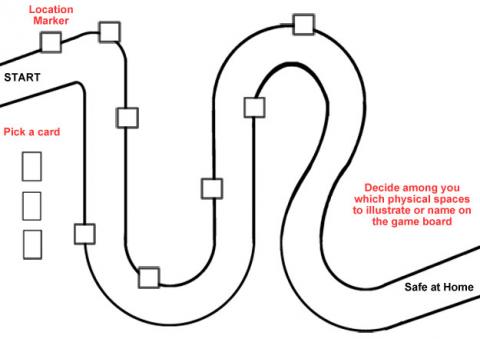
This lesson invites students to reconfigure Meg’s journey into a board game where, as in the novel itself, Meg’s progress is either thwarted or advanced by aspects of her emotional responses to situations, her changing sense of self, and her physical and intellectual experiences.
Madeleine L’Engle won the prestigious Newbery Award Medal for her science fiction fantasy A Wrinkle in Time. Her acceptance speech, entitled “The Expanding Universe,” states:
What a child doesn’t realize until he is grown is that in responding to fantasy, fairy tale, and myth he is responding to what Eric Fromm calls the one universal language, the one and only language in the world that cuts across all barriers of time, place, race, and culture.
A Wrinkle in Time resonates with universals that reflect and transcend the concerns of the time during which it was written. Published in 1962 after numerous rejections, A Wrinkle in Time emerged as the U.S. and Soviet Union raced to be first to reach the moon. The novel echoes the frosty political climate of that era when a Cold War was being waged between the two super powers.
Learning to express one’s individuality despite the pressure to conform is a standard initiatory trial for every young adult in every generation. As Mrs. Whatsit reflects near the end of the book, “You’re given the form, but you have to write the sonnet yourself.” Meg Murry’s struggle to become herself and to be true to that self is as central to the novel as the battle between good and evil in which she plays a critical role.
Though the novel has won acclaim from critics over the years, it has also found itself the target of book challengers. A Wrinkle in Time has been on the American Library Association’s Top 100 Banned/Challenged Book List for the last two decades, ranking 23rd on that list in the 1990s and 90th in the 2000s. Various groups have challenged it, saying the book undermines their religious beliefs. Though L’Engle’s books contain biblical references, she denied that they convey any religious message.
Despite the controversy A Wrinkle in Time raised, L’Engle went on to complete a full series of books—often referred to as The Time Quartet/Quintet—populated with the same characters. Brimmingwith mystery, horror, and magic as well as science fiction, the other novels in this series also have Christian elements that underlie the challenges they too receive year after year.
Beyond its mystical aspects, the novel can be read as the archetypal journey of a young hero undergoing coming-of-age trials. On her quest, Meg gains insight into what it means to be a friend, a sister, a daughter and a young adult involved in the difficult work required to become a fully realized human being. The time Meg spends in a dystopia makes her home seem a utopia by comparison. To complete her mission and return home, Meg must forge her character and offer herself up as a sacrifice to save others she loves from harm.
Complete worksheets 1a and 1b.
Meg’s explicit goal is to save her father, but students should also understand (perhaps with your help) that she needs to like herself more, feel more comfortable with others, become more sure of herself, and be open to grow and change. Discuss as a class what hinders Meg’s progress in achieving her goals.
Encourage students to be specific about Meg’s responses to other characters or situations. If they want to include some of the particulars of the different spaces Meg travels to, encourage students to explain what it is about that space (cold, darkness, the lack of dimension, the uniformity, etc.) that impedes her and why it does so (causes fear, causes pain, oppresses).
Students might include other internal and external impediments: fear; insecurity; anger; belligerence; physical pain; loneliness; boredom; time constraints; language inadequacies; a tendency to blame; IT itself and all they think IT stands for.
Students then should consider the inner attributes and outside forces that help Meg build her confidence and surmount obstacles on her journey. Students might include internal and external forces: friendship; Meg’s quickness of mind, her aptitude for math and ability to find her own short cuts in solving a problem; loyalty to family; stubbornness; benevolent guides (Mrs. Whatsit; Mrs. Who and Mrs. Which); courage; her “faults” including impatience; Mrs. Who’s spectacles; the periodic table of elements; Aunt Beast; and love. (See Worksheets 1a and 1b.)
1. Make the cards
2. Create the board

3. Play the game(s)
To keep the game playing under control, consider having three players per game (and in each small group). Though every player is Meg, each will need a separate playing piece and, perhaps, a different track to move along. A roll of dice can determine where a playing piece stops, with spots where players are required to pick cards every few blocks. Ideally, let groups have the chance to play their own and at least one or two other games, to experience the choices made by their peers.
Assess how and why Meg succeeded in her trials. In essence, this serves as a review and summary of the material in Activity 1. The class will discuss how Meg used her character, relationships with others, emotions, and intellect in the course of her quest and why she ultimately returns home triumphant.