


Lesson 2: What's In A Name? British Surnames Derived from Places
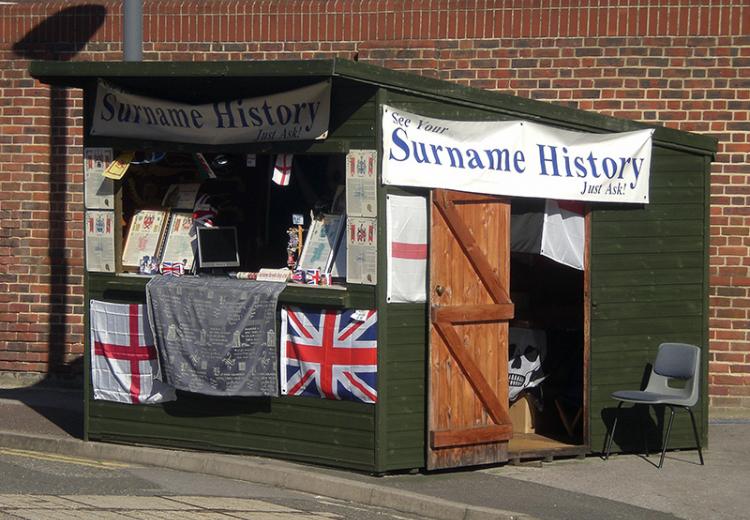
A stand at Portsmouth Historic Dockyard offering information on surname history.
Over half of all English surnames used today are derived from the names of places where people lived. This type is known as a locative surname. For example, a man called John who lived near the marsh might be known as John Marsh. John who lived in the dell was called John Dell. Other examples are John Brook, John Lake, and John Rivers. Some names combined two words, such as Underhill (someone who lived at the foot of the hill) and Hightower (dweller of the high tower).
- Many names had the following endings: -ford (the crossing place in a river or stream), -fort (a fortification), -field (an open area where fairs were held), -brook, -wood, and -well. Ashwood, for example, would describe someone who lived in a wood of ash trees.
Certain locative surnames are less clear in meaning, since they are derived from earlier forms of English. For example, who would guess that Dunlop means “a muddy hill!” Below are a few helpful clues for determining the meanings of this type of name.
- The prefix atte meant “at the.” It appeared in names like Attewood and Attewater, which later evolved as Atwood and Atwater.
- Frequently used place nouns were den (valley), beck (brook), more (river bank), and adder (stream). Beckford referred to someone who lived near the crossing place of a brook.
- The endings -ton, -ham, -wick, -stow, and -stead meant “farm” or “town.” So the name Denton (den plus ton) referred to someone who lived in a town or farm in a valley.
- Other commonly used place endings were: -don (a hill), -bury (a fortification), -leigh or -ley (a clearing), and -chester (site of an ancient Roman fort).
In some cases, the preposition "of" was simply added to the name of a town to form a person's byname. Examples are John of York and William of Orange.
Guiding Questions
What are locative surnames?
Learning Objectives
Students will develop an understanding of British surnames derived from locations and learn some of the more common names still prevalent today.