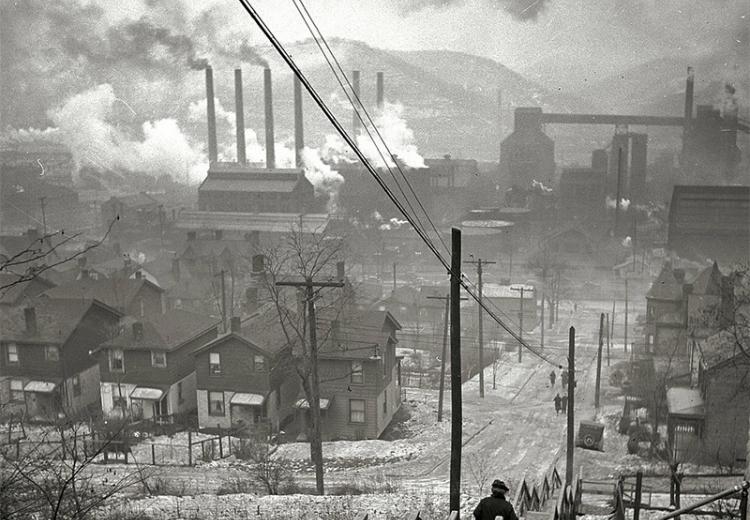

Image Courtesy of American Memory.
In the decades before the Civil War—a period sometimes dubbed the First Industrial Revolution—a significant number of inventions and innovations appeared, transforming American life. A telegraph system allowed information to flow from place to place more quickly than the speed of a horse. A transportation system based largely on steam power allowed goods to be shipped great distances at reduced expense. Also of great consequence was the development of the “American system of manufactures”; this system, in which individual workers were responsible for only part of a finished product, helped make store-bought goods more affordable. As a result, people began to buy goods from stores rather than making them—the American consumer was born.
Impressive achievements to be sure, but revolution means dramatic, rapid change. Are the changes that took place in manufacturing and distribution during this period best described as a "revolution" or as steady change over time? What research tools can help students judge the nature of change during the First Industrial Revolution? Can answers be found in census data? This lesson provides students with the opportunity to form, revise, and research questions for an investigation of the First Industrial Revolution, using resources available on EDSITEment-reviewed websites and links.
Note: This lesson may be taught as a stand-alone lesson or in combination with the complementary EDSITEment lesson plan Was There an Industrial Revolution? Americans at Work Before the Civil War.
Establish an anticipatory set; share with the class the following selected Newspaper Ads from 1840 (Alton Telegraph, Illinois), found on the EDSITEment resource At Home in the Heartland:
By 1840, goods people had previously made for themselves were sold cheaply enough at stores to make the purchase worthwhile.
One of the reasons store-bought goods became inexpensive was the development of the American system of manufactures, in which individual workers made only part of a finished product. This differed from earlier practices, in which someone skilled in a craft, toiling at home or in a shop, started with raw materials and worked through the entire creative process alone.
Share with the class the brief article The Two Countries That Invented the Industrial Revolution from Internet Modern History Sourcebook, an extension of the EDSITEment resource Internet Medieval History Sourcebook.
By 1851, the U.S. began to be known internationally for its manufacturing. If desired, share with the class the following brief article, which expands on this fact: Engines of Change from the Smithsonian National Museum of American History, a link from EDSITEment resource American Studies at the University of Virginia.
Now, students will attempt to gauge the level of change in pre-Civil War America. How great was the change from the craft system to the factory? To demonstrate to the class the differences between the craft approach typical of colonial manufacture and the American system of manufactures developed by Eli Whitney (among others) for his armory, conduct the following simulation, which is taken from the lesson "Workers on the Line," offered by the Tsongas Industrial History Center, an educational partnership of the University of Massachusetts Lowell Graduate School of Education and Lowell National Historical Park (and a link from the EDSITEment-reviewed website Whole Cloth). If desired, share with the class the following information, also from the "Workers on the Line" lesson, which is available for download from the Tsongas Center's online Curriculum Materials Page:
Cottage Industries to Factory Production
Before the Industrial Revolution, most goods were created by hand by craftsmen classified into three categories: apprentice, journeyman, and master craftsman. A master craftsman was a person who had mastered all the techniques and skills of a given craft. After many years of practice, he was regarded as an expert who then passed along his knowledge and skills to apprentices, young boys who spent many years under his direction. A journeyman was a craftsman who had completed apprenticeship but did not yet have the experience or skill to be designated a master. A craftsman knew the whole process of creating an object; for example, each woodcrafter knew how to create a chair from start to finish.
With the advent of the Industrial Revolution, the job of creating an object became broken down into many steps, each of which was done by a different person. In the case of the wooden chair, one person might lathe the legs, another would create the seat, another would make the arms and back, and all the parts would then go to yet other people who would assemble them. The advantages were that single tasks could usually be done over and over faster than when one person did everything start to finish.
—"Workers on the Line," p. 6 (NOTE: This is a PDF document.)
Download, copy, and distribute to students the “In-line Skate” sheet on page 1 of the PDF, but before you begin the Craft Simulation Activity, below, allow students to set standards for what is an acceptable finished product. For example: Can you establish a margin of error for the cutting-out process? What are the minimum coloring standards? When establishing the "standard time," only count the time involved in making skates that met the standards.
Explain that they are each a craftsperson who will assemble the skates start to finish. They must be cut out, blades glued on, and colored to the best of their ability. Each will be asked to track the amount of time it takes to complete the task. After everyone has completed the skates, compile and average the different times it took all the students to complete the task. This will be the "standard" time it takes to produce in-line skates by hand. Point out the differences in "quality" among the hand-created skates. Are there some who have apparently mastered the craft of making in-line skates and some who still need some time as apprentices?
—"Workers on the Line," p. 6 (PDF)
Next, conduct the Factory Simulation Activity. Divide the class into three to five efficient groups to create five production lines. Assign tasks to different students on the line:
(NOTE: Depending on the size of your group, combine the following tasks: 1+2, 3+4, 5+6.)
Using the "standard" of time determined during the craft lesson, see how many skates can be created during the same amount of time. Do the same activity again and see which of the production lines can produce even more skates …
—"Workers on the Line," p. 8 (PDF)
… after allowing the groups to meet briefly to discuss improving efficiency. Now, have each student complete the “Craftsmen Versus Factory Line Chart” on page 2 of the PDF.
Discuss the results and the personal feelings students had about the two methods. Here are some guiding questions:
—"Workers on the Line," p. 8 (PDF)
What are the connections between the way factories at the height of the Industrial Age were structured and the process the class just simulated? What are the differences between an assembly line and the American system of manufactures? What would the students say was the greater change—from craft to factory (perhaps the essential change of the First Industrial Revolution), or from factory to assembly line (one of the essential, though later, innovations of the Second Industrial Revolution)?
Talk about the "in-line skates" students created in Activity 3. Ask them some questions about in-line skates. How many students own them? How many have ever tried them? When did such skates become popular? When do students think they were invented? Share with the class an image of an early version of inline skates, available on the Smithsonian National Museum of American History, a link from the EDSITEment resource American Studies at the University of Virginia. Ask students if they recognize the object. Tell them these skates were created in 1823.
Now share the text about the skates with the class. Inline skates have not changed that much in almost 200 years! That would seem to indicate that the greatest change in inline skating took place in 1823, when they were invented (albeit in England), or perhaps in 1863, when an American innovation started a craze in roller skating. When students take a look at some inventions and innovations of the First Industrial Revolution, will they find that the greatest changes took place then or between then and the height of the Industrial Age?
If desired, share with the class either or both of the following timelines to give students a sense of the chronology:
Divide the class into five groups. The students' task is to identify essential similarities and differences between the technology of the pre-Civil War period and that of the height of the Industrial Age, using EDSITEment resources and links as well as other materials available in the classroom or library. To summarize their findings, groups can use the chart “Two Technologies: The First Industrial Revolution Versus the Industrial Age” on page 3 of the PDF (see Preparing to Teach This Lesson, above, for download instructions). Unless otherwise noted, the images and texts cited below are from the Smithsonian National Museum of American History, a link from EDSITEment resource American Studies at the University of Virginia. You can click on most Smithsonian images for enlargements. (NOTE: Some students may find it useful to see Industrial Age versions of similar inventions. Links to some images from the EDSITEment resource American Memory—in bold font, with approximate dates of photographs—are included below the image of the object from the Industrial Revolution.)
Factories and Machines
Transportation
Scientific/Commercial Instruments and Innovations
Agriculture
Communication
Have groups share their results. Did most ratings indicate great or small change since 1860 (with "small change" implying that the greatest change occurred before 1860)? This exercise had a built-in bias in that all of the objects existed prior to 1860. What contemporary inventions and innovations would students say represent the most significant change from the pre-Civil War era? Which of these belong to the Industrial Age (which began to end sometime after World War II), and which belong to the current Information Age (only comparisons to Industrial Age inventions and innovations are applicable in this comparison)?
Review with students the proper use of the United States Historical Census Browser, available via a link from the EDSITEment resource History Matters. Introduce the census browser and allow students to practice with it until they are able to use it on their own. Here are some basic instructions, using the 1840 census. Be aware that there are differences in categories between census years.
Working in their groups, students should obtain data on each topic indicated below, using the census years shown:
Before they get to work, have students decide how a radical change in the economy (expected to be seen as an improvement in quality of life) might be reflected in their topic area. For example, if the standard of living is improving, we would expect an improvement in longevity. Changes in slave population and ownership is a thorny category, because slave owners might consider possession of more slaves an improvement in standard of living, while those enslaved certainly would not. Students need to take such matters into account as they work with the data.
Each group should explore the data for some time and then form research questions. What are they going to look for and how will they work with the data? Students can expect their questions to change a bit as they become more familiar with the census browser.
Does the census data indicate that great change occurred between 1790 and 1860? Does the data indicate that a large number of people benefited from the changes that took place?
Students should organize their information in terms of findings and conclusions. If desired, provide each group with the appropriate chart from the following list of charts, available on pages 4-9 of the PDF:
Ample room has been provided on each chart for questions, but let students know that not every space for every year must be filled.
Have each group share its findings with the class. After all have finished, everyone should take a stand—was the First American Industrial Revolution really a revolution? If desired, let any disagreement among students lead to a class debate.
9-12
4-5 class periods