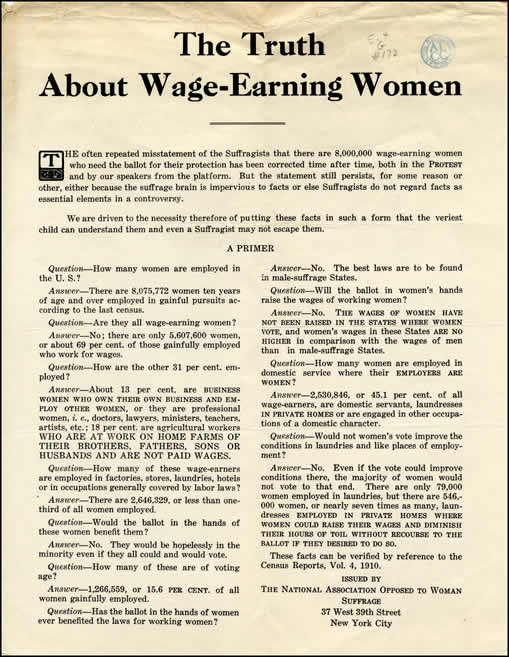
An article originally published in the 1991 Session Weekly of the Minnesota House of Representatives recalls the arguments put forth in objection to the Minnesota Equal Suffrage Association's decision, early in the 20th century, to push for the right of women to vote in presidential elections. One lawmaker declared that all-male voting was "designed by our forefathers." Later, Rep. Thomas Girling argued that "women shouldn't be dragged into the dirty pool of politics." Approving such a measure, he said, would "cause irreparable damage at great expense to the state."
When the Senate took up the bill, one member asserted that "disaster and ruin would overtake the nation." Suffrage would lead inevitably to "government by females" because "men could never resist the blandishments of women." Instead, he recommended that women "attach themselves to some man who will represent them in public affairs."
Though such arguments may now sound rather ridiculous to some, they are closely related to entrenched views of women that took more than a century to overcome (assuming one agrees they have been overcome). Understanding the positions of the suffrage and anti-suffrage movements—as expressed in archival broadsides, speeches, pamphlets, and political cartoons—will help your students better appreciate the struggle for women's rights and the vestiges of the anti-suffrage positions that lasted at least through the 1960s and, perhaps, to the present day.
Note: This lesson may be taught either as a stand-alone lesson or as a companion to the complementary EDSITEment lessons Women's Suffrage: Why the West First, Who were the Foremothers of Women's Equality?, and Women's Equality: Changing Attitudes and Beliefs.
After completing the lessons in this unit, students will be able to
To establish an anticipatory set, begin by sharing with students the Currier and Ives lithograph The Age of Brass/or the Triumphs of Women's Rights, available on Picture History. Before giving any background or guidance, encourage students to report what they notice in the lithograph. Then, in a whole-class setting, use the Cartoon Analysis Worksheet offered by the EDSITEment-reviewed National Archives website Teacher's Resources to analyze the illustration. Tell students they will be much better equipped to do such analyses when they have completed the other activities in this lesson.
Share with students the first paragraph of the Introduction, above. Was the legislator correct when he said that all-male voting was "designed by our forefathers?" As a class, read the 19th Amendment to the U.S. Constitution (ratified 1920), available in a Transcript of Amendments 11-27 on the EDSITEment resource Digital Classroom. What does the amendment say? Now have students scan the text of the Constitution. (A Transcription of the U.S. Constitution is also available on the National Archives website Teacher's Resources.) Are women expressly forbidden from voting? Why was the 19th Amendment necessary? Women did vote in some states in the early days of our republic.
Share with students the document 1797, An Act to regulate the election of members of the legislative council and general assembly, sheriffs and coroners, in this State, available on the Scholarly Communications Center of Rutgers University Libraries, a link from the EDSITEment-reviewed website Women and Social Movements. What does the document indicate about voting in the state of New Jersey? (Women did vote.) Nevertheless, later acts rescinded the right of suffrage for women in every state—share with students the document Who Shall Not Vote 1807, also available on the Scholarly Communications Center of Rutgers University Libraries.
What about the post-Civil War Constitutional amendments? Didn't they grant universal suffrage? Read the 14th and 15th Amendments (a Transcript of Amendments 11-27 is available on the EDSITEment reviewed Teacher's Resources. Note that the 14th Amendment specifically uses the word "male." The 15th does not, leaving open the possibility for a state to grant women the right to vote.
Though passed in hopes of enforcing the rights of freed slaves to vote, a less well-known act of Congress—the Enforcement Act of 1870—was used to convict Elizabeth Cady Stanton of voting illegally. Download, copy and distribute to students the "Enforcement Act of 1870" on page 1 of the Pro-and Anti-Suffrage Worksheet, available here as a PDF. Can students find the clause that was used against Stanton?
The Founding Fathers never specifically banned women from voting, but the states did have that power and used it. What we might call a technicality in the Federal law was also used to enforce the ban.
If desired, students can now fill in the first section of the chart "Pro- and Anti-Suffrage Arguments" on page 2 of the PDF.
Share with the class the document A Petition for Universal Suffrage (circa 1865), an early plea to Congress, available via a link from the EDSITEment-reviewed website Teacher's Resource. What are some of the issues Stanton, Anthony, Blackwell, Stone, and others included in the petition?
If you have not already done so, pass out the chart "Pro- and Anti-Suffrage Arguments," on page 2 of the PDF (see Preparing to Teach This Lesson), for students to use during the following activity.
Divide the class into eight groups. The archival documents listed below will allow the groups to explore specific issues. The selected documents have a common theme or themes, but are not necessarily limited to any particular theme. If possible, create overheads or multiple copies of documents as requested by groups.
Following their research, student groups should present their documents in a point/counterpoint fashion, having at least two speakers—each of whom represents a position as expressed in a particular document—speak in turn when possible.
Once again, show students The Age of Brass/or the Triumphs of Women's Rights on Picture History. Would students analyze it differently now than they did when this lesson began?
If desired, use the list of archival cartoons below as a check for understanding. It can be used in a variety ways:
Regardless of which method you choose, students can use the Cartoon Analysis Worksheet, available on the EDSITEment resource Teacher's Resources, for guidance.
Abolition and the Early Women’s Rights MovementMany of the early activists for women's rights became politicized through their interest in abolition. In an 1837 letter to Catherine E. Beecher (from Digital History), Angelina Emily Grimke, an early leader in the movement, explained how her interests expanded from antislavery to women's rights. Commentary from The Gilder Lehrman Institute of American History elaborates.
From the abolition movement, grew the Women's Rights Movement. For an online documentary movie about the formative years of the movement with an emphasis on Elizabeth Cady Stanton and Susan B. Anthony (based on Ken Burns' television documentary), click on the image on the left-hand side of the home page of PBS's Not For Ourselves Alone (a link from the EDSITEment-reviewed website New Perspectives on the West) to access audio and video. Note the connections the documentary makes between the Women's Rights Movement and temperance and abolition movements. The first 12 online episodes are especially relevant for providing background on the formative years of the movement. (NOTE: Each episode is a brief loop; click on the next number to continue.)
Share the first four pages of the illustrated satirical poem from the 1960s "There Was a Young Woman Who Swallowed a Lie" by Meridith Tax, also available on the EDSITEment resource African-American Women: Online Archival Collection:
Which issues from the previous discussion did she raise? What new issues did she raise?
Both of these documents were from the 1960s. Are any of the issues from the early suffrage movement still issues today? Students could create a poll to try to gauge the answer. If students in the class disagree, a debate could be conducted. (The topic of women's rights is still contentious: monitor the debate closely.)
4-5 class periods