
Franklin D. Roosevelt signing the Social Security Act, August 14, 1935.
Credit: Image courtesy of the Library of Congress.
We can never insure one hundred percent of the population against one hundred percent of the hazards and vicissitudes of life, but we have tried to frame a law which will give some measure of protection to the average citizen and to his family ..."
—Statement of Franklin Delano Roosevelt upon signing the Social Security Act, August 14, 1935
During the Great Depression of the 1930s, unemployment devastated the lives of individuals and undercut the nation's economy. Older Americans as a group were particularly affected by this economic crisis. Improvements in medicine and public health meant people were living longer, yet many elderly Americans faced age discrimination that made it difficult to find employment. As a result, the Social Security Act (SSA) was enacted on August 14, 1935 to help older Americans deal with this problem.
This lesson engages students in the debate over Social Security that engrossed the nation during the 1930s. Students will be given the opportunity to examine the 1935 Social Security Act, and to read, listen, and watch the debates surrounding the development of this important legislation.
The activities in this lesson have students use primary source documents to develop their own points for a debate. In addition, analysis of visual, audio, and video sources will enable the students to evaluate the reasons for the creation of this act and related agency.
How did the passage of the 1935 Social Security Act transform the role the federal government plays in the lives of the American people?
Upon completion of this lesson, students should be able to
On August 14, 1935, the Social Security Act (originally called the "Economic Security Bill") was enacted by the 74th Congress to give older Americans a pension that would ensure a reasonable standard of living as they aged. In addition, the Social Security Act provided unemployment insurance for workers, aid to needy children who had lost one or both parents, and disability insurance for workers who could not work on account of an injury.
Franklin Roosevelt had established old age pensions for the State of New York when he served as governor. By the time of his presidency, controversial figures such as Huey Long, Frances Townsend and many others had publicized their own plans for remedying the economic crisis and the plight of the impoverished elderly. The President set up a Committee on Economic Security to study the problem and make recommendations. In the United States, direct federal or state pensions for the poor had a limited history. In Europe, however, there was a long tradition of government action to provide for citizens' economic security.
The Social Security Act was politically moderate. It was to be funded by both employees and their employers, instead of redistributing general tax money. Still, it represented a milestone in moving this country toward a modern welfare state; as a result of this legislation, the United States joined other industrialized nations in offering old-age pensions and unemployment compensation. The move, however, met a great deal of resistance from a variety of constituencies. The links below contain a broad range of perspectives that should help provide background on the issues relating to the Social Security Act.
This lesson revolves around three main points:
Images:
This activity is available as a series of LaunchPads divided by group.
Step One: Have the students review the Great Depression time line and the section entitled "The Stock Market Crash and The Great Depression" on The Historical Background and Development of Social Security page, and ask them how the Great Depression may have affected the lives of working class Americans.
From this starting point, ask the students to think about how the Great Depression may have affected older workers differently from younger workers. Using this discussion, have your students read the Preamble to the Social Security Act.
After reading the information from these sites, ask the student to answer the following questions:
Step Two: Students will use four primary source documents to learn about the debate over the Social Security Act that took place from 1935-1937. This activity will introduce students to key arguments supporting and opposing the establishment of Social Security; students will then build on this knowledge in Activities Two and Three.
Divide the class into four groups (A-D) and assign one document to each group. These four documents are available as student LaunchPads below. Each group should receive a set of one of the four documents; each student will need their own copy. In their groups, the students should read and analyze their document, then collaboratively complete the following tasks:
Do you agree or disagree with the author of your document? Why or why not? Do you think contemporaries would have found his or her arguments convincing? Why or Why not?
If they go to the website for this reading, students should read paragraphs 3 through 7, and paragraph 9.
Step Three: After each group has completed their task, ask the students to discuss their answers to the four questions given above and distributed with each of the handouts. As a class, create a T-Chart to evaluate the reasons why people were either for or against this act. Conclude this activity by asking students to decide which of the positions, taken in the context of the times, was strongest and why. T-Chart is available here.
This activity is available as a Student LaunchPad.
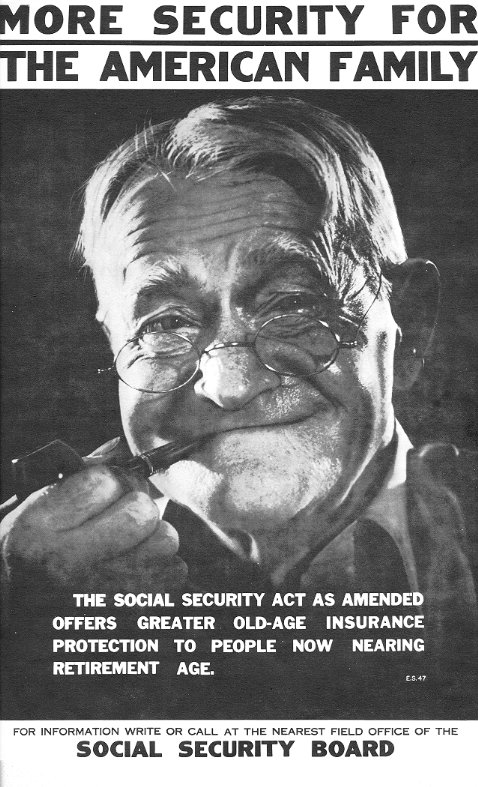
Step One: Students are to access the Social Security Act posters listed below to identify the ways in which the federal government was trying to build support for the Social Security Act among the American public.
Step Two: Ask the students to mark up and annotate the images, guided by the following questions:
Step Three (optional): Critical Thinking Challenge—Race, Gender and the SSA
After completing steps one and two above in this activity, have the students review the posters above and the training mid-wives photo from this time period (though not related to the selling of the Social Security Act). Once students have looked at these four photos, the students should be encouraged to discuss the ways in which concepts about race and gender were used (or not used) to help sell the Social Security Act. Students annotate the training mid-wives photo as they annotated the Social Security images in Step Two.
This activity is available as a student LaunchPad.
Step One: Have students read Digital History's short overviews of Social Security and African Americans and the New Deal. Digital History is an EDSITEment-reviewed website.
Step Two: Access America's Town Meeting of the Air, "Should We Plan for Social Security?" of December 19, 1935 for the debate on the SSA, and download each speech by Francis Perkins and George Sokolsky as outlined in Preparing to Teach the Lesson. Transcripts of their statements are available in a separate PDF. Suggestion: you may have to listen to these recordings more than once for the full meaning.
Step Three: Play Francis Perkins' statement from minute 11:20 to minute 14:50, having your students listen to the remarks that Francis Perkins made in support of Social Security and answering the following questions:
Step Four: Have your students listen to the remarks made by George Sokolsky, playing the audio clip from minute 6:22 to minute 9:35, and answer the following questions:
Step Five: The Town Meeting of the Air was a live radio discussion on an important topic of the day. Students will take the role of audience members and continue the discussion. Students should use their notes from Activities One and Two, as well as the radio debate in this activity. The teacher should, in advance, assign some students to roles such as business leaders opposing Social Security, New Deal officials supporting it, some members of state government who might have a comment on the state role, small business owners, workers, women, and African-Americans who might have a variety of perspectives on social security. Specifically, as the students prepare their roles, they should explore and identify how their person would most likely think about the Social Security Act (i.e., how would it impact their life; how would a farmer, factory worker, small business owner, woman, African American, etc. look at the Social Security Act from his/her point of view). The teacher should take the role of the host of the program, moderating the discussion.
Extended Time Option: If you have more time available to conduct this activity, it may be useful to have students listen to more of "Should We Plan for Social Security?" on America's Town Meeting of the Air. By listening to the longer segments of Perkins' and Sokolsky's arguments your students may be able to better identify the role the audience may have played in this debate, as well as what audience reaction might tell us about attitudes concerning Social Security at that time. For example, Mr. Sokolsky's speech received a much warmer response than Francis Perkins' did. What might this reaction imply? Since this activity has your students playing the role of the audience, finding the time to listen to each speech in full may increase your students' understanding of the debate surrounding this topic.
FDR's Speech at the signing of the Social Security Act, 1935, Video Clip. (Go to Social Security Online: Sights and Sounds, scroll down to section 2: FDR's Speech).
Women, the Social Security Act, and the Supreme Court
9-12
2 class periods