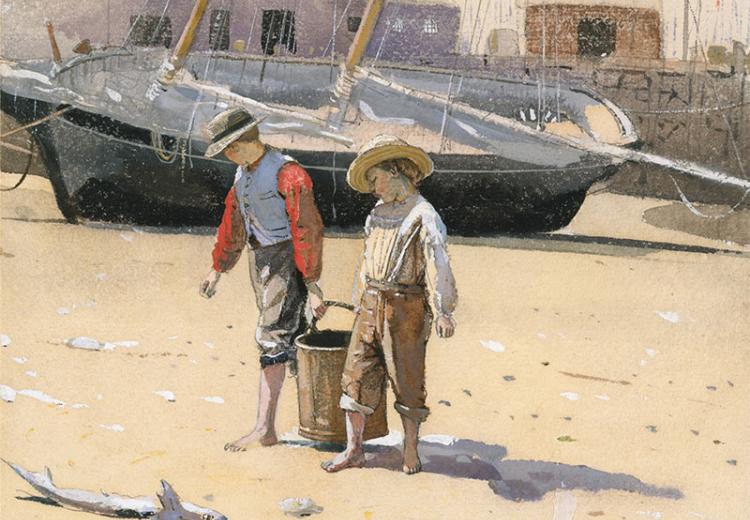

"Basket of Clams" by Winslow Homer (American, 1836–1910).
Credit: Image courtesy of American Memory at the Libray of Congress.
Impressionism, Cubism, Realism, Neoclassicism, Mannerism. When we visit a museum or flip through a book we often see these terms, along with the word movement (or sometimes style). But what makes a painting an example of the Impressionist or the Neoclassical movement?
This lesson plan will help students to understand the idea of movements in the visual arts, and begin to differentiate between some of the most well known movements in Western art- particularly in painting. This lesson can be taught in conjunction with the EDSITEment lesson plans What’s in a Picture? An Introduction to Subject in the Visual Arts and Portraits, Pears, and Perfect Landscapes: Investigating Genre in the Visual Arts.
What is an art movement? What are some the characteristics of the most famous movements in Western art?
Movements in art refer to a philosophy or a style in painting or sculpture that is followed by a group of artists—with varying adherence—over a set period of time. Movements proliferated particularly in Europe and America during the 19th and 20th centuries, and the list of movement names is extensive. Many of them will be familiar to you and your students, and this lesson plan will focus primarily on some of the best known movements. Information on many of these movements is available through the EDSITEment-reviewed web resource Internet Public Library. This lesson will concentrate on Impressionism, Realism, and Romanticism. Below are links to information about some of the most well known movements:
• Impressionism
• Romanticism
• Abstract Expressionism
• Realism
• Cubism
• Harlem Renaissance
• Neoclassicism
• Surrealism
This lesson provides a guide for introducing students to the concept of artistic movements in the visual arts, however the discussion of individual movements will be limited. You may wish to delve more deeply into some of these movements in conjunction with larger lessons about the relevant time periods- such as a world history lesson investigating the rise of Neoclassicism and the French Revolution or an introduction to Romantic painting in a literature lesson on Romantic poetry. The above links provide an introduction to background information on some of these movements.
Note: Movement is a term that is most often used in reference to European and American art, and as a result this lesson will concentrate on art from these areas.
This activity will introduce students to the concept of movement in the visual arts, as well as to a limited number of movements in Western art with which they may already be familiar.
Students should be able to pick out the numerous differences in the ways in which Decker and Renoir have approached their subject. But are these differences just the result of personal preferences or styles, or are they representative of an artistic movement? In this exercise students will look at additional images of the movements these artists represent in order to gain perspective on the scope of artistic movements and the difference between the stylistic choices of a movement and personal choices in style and expression.
In the related sets of images contained in the last two activities students were asked to compare examples of two movements whose features are both distinct and dissimilar. In this activity students will put their observations and inventories to work to see if they are still able to identify an Impressionist painting when it is compared with an example from a third movement.
Because of the sketchy sky and background in this work, some students may have instead identified the Bonington as an Impressionist work. If you have students who saw aspects of Impressionism in this work ask them to explain what those aspects are.
In the definition of an art movement given at the beginning of this lesson it is described as referring to a philosophy or a style in painting or sculpture that is followed by a group of artists over a set period of time. What kind of philosophy underlies art movements? This activity will help students to begin to think about the philosophical or theoretical underpinnings of some art movements.
After they have read the article on Romanticism have students compile a list of some of the philosophical ideas or beliefs that were the foundation of the Romantic Movement according to the reading. This list should include features such as the focus on the imagination and on emotion; the interest in symbols of history and the romanticizing of the past; and the rebellion against social constraints and the rise of the cult of the artist. Students might also note features such as the focus on the dramatic and the tragic, as well as the attention paid to the connection between man and the natural world.
The painting is based on Sir Walter Scott’s historical novel Ivanhoe, which tells the tale of rival claimants to the English throne, and the bloody civil war that comes of their fight for power. Scott and Delacroix were contemporaries (Ivanhoe was published in 1819- just three years before Delacroix made his first submission of a painting to a Paris Salon), and Scott was much beloved by many of the Romantics for his sweeping historical novels, of which Ivanhoe was one. In fact, Scott is often thought of as the first person to write an historical novel—his novel Waverley, which was published in 1814. You might begin with a class discussion on the following points:
Now that students have had a chance to learn a little more about Romanticism, Impressionism and Realism, they will get a chance to put that new knowledge to the test.
Note: Many paintings contain elements of more than one movement. For example, there may be elements of Realism among the Romantics or the Impressionists, so students shouldn’t focus on searching for a pure or perfect example of each movement. Instead, they should concentrate on which movement is the best fit for each painting and why. It might help students to know the time periods of each of these movements, so that they might better understand that some of these movements were overlapping or very close in time period:
Students at all levels should complete either the PDF chart or the online interactive for Activity 5. In addition, ask beginning students to choose two paintings from this list which represent two distinct movements. Have students compose short essays analyzing the ways in which each of the two images contain the criteria of their movement. They should compare and contrast the images and their corresponding movements throughout the essay.
For advanced students, or for classes with more time, you might wish to assign a more in-depth research project. There are a far greater number of Western art movements than can be covered in a short lesson, although this brief introduction to the concept of movements and to Realism, Romanticism and Impressionism may have piqued students’ interests.
Provide students with a list of art movements that does not include Realism, Impressionism or Romanticism. The list might include—but need not be restricted to—the following movements:
Students should choose one movement from the list. This movement will be the topic of a research project. Students should gather information on the movement, including the qualities that characterized works typical of the movement; the ideas that were the underpinnings of the movement; the history of the movement and its major followers. For this project- which might take the form of a class presentation or a research paper—students should use at least three works of art which exemplify the movement they have chosen, analyzing the ways in which the pieces do or do not meet the criteria of the movement. You may wish to direct your students to conduct this research- particularly for images—by using the collections available from the following EDSITEment reviewed web resources:
Painters were not the only artists to follow artistic movements, and some movements had a broader effect than others. In this extension activity students will take a brief look at the ways in which the philosophies underlying art movements have manifested in other media, such as literature.
9-12
4-5 class periods