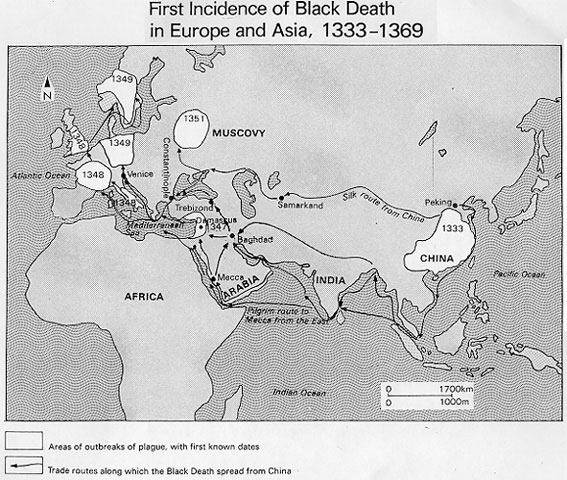

The Black Plague cut a huge swath of devastation through the heart of 14th century Europe.
Europe in the first half of the 14th century seemed to be preparing itself for significant changes. Cities grew in importance, though most of the population was still rural. Population increases had led to overuse of the available land. Poor harvests—also due to cooler, wetter weather—led to famines. The serf system was being undermined. Centralized political authority was becoming more powerful. Then the Black Death cut a path—both literal and figurative—through the middle of the 14th century. The disease was caused by the bubonic plague, which was spread by rats, whose fleas carried the plague bacilli from the East along trade routes until it penetrated almost all of Europe, killing at least one out of every three people.
Such a radical alteration in population in any place, at any time, would likely set off dramatic changes in society. What happened in a Europe already beginning to transform itself? In this lesson, students analyze maps, firsthand accounts, and archival documents to trace the path and aftermath of the Black Death.
Students completing this lesson will be able to
The following materials from EDSITEment resources may be useful to teachers seeking expert advice on the use of primary documents:
Analysis of Primary Sources on The Library of Congress, a link from American Memory, may be helpful to students preparing to interpret primary documents. This succinct but valuable lesson offers three basic steps for analyzing primary sources:
In October of 1347, in Messina, Italy, on the island of Sicily, the plague first arrived in Europe. To introduce this devastating disease, share with your students A Firsthand Description of the Plague (without the sentences about the Genoese ships) accessed through a link from the EDSITEment website Geoffrey Chaucer. (Note: This account—composed by a witness, Michael Platiensis, to the events in October, 1347—was written in 1357.) Discuss the following:
(NOTE: Details of the symptoms of the disease and the practice of medicine at the time are not the focus of the lesson and should be regarded as an extension for individual research. However, explain to students that most medical authorities agree that the disease called the Black Death was bubonic plague spread by fleas on rats and originated in Asia. Although the exact cause was unknown until much later, the disease was virtually untreatable without modern antibiotics. Students with such interests can conduct their own exploration into what was believed regarding the causes and treatment of the disease at the time, and the probable effect of some of the measures taken to prevent the spread of disease and on hygiene in general. See Extending the Lesson below.)
After completing the class discussion on the movement of the plague, have students work independently using the EDSITEment interactive The Path of the Black Death or the downloadable PDF, The Path of the Black Death in Europe.
NOTE: The dates on the interactive map are based on a map found on Decameron Web, as well as the map Spread of the Black Death, both accessible through the EDSITEment-reviewed website Geoffrey Chaucer and some firsthand accounts of the plague.
When students have finished working independently on the map exercise, have volunteers share with the class their answers to the questions in the interactive or PDF document.
Now, share with your students the first sentence of A Firsthand Description of the Plague, which states that the plague arrived at Messina on Genoese ships.
The immediate effects of the plague were devastating. In this activity students will read primary sources in order to gain a better understanding of the spread and effects of the disease. Begin by asking students what answers, if any, primary sources can provide for the following:
Discuss the likely answers to the questions above after students have read one or more additional firsthand accounts of the plague on its path through Europe, such as:
(Boccaccio may not have witnessed the plague firsthand in Florence, but his father was a health official.)
Next, discuss the extent of the plague after reading with the class the first two paragraphs of an account contemporary to the plague, Jean de Venette on the Progress of the Black Death (accessible through a link from EDSITEment resource Internet Public Library) , starting with the words, "Some said that this pestilence …" (third paragraph) It offers a witness' perspective on the progress of the disease in Europe.
Share the map Spread of the Black Death accessible through EDSITEment resource Geoffrey Chaucer., which shows a more comprehensive view of the extent of the plague.
Finally, have students attempt to gain an idea of what kind of impact the disease had on the size of Europe's population. In Florence, Italy, after the plague subsided, an attempt was made to calculate the effect on the population. Share the very brief description How Many Of The Dead Died Because Of The Mortality Of The Year Of Christ 1348, from EDSITEment resource Internet Medieval Sourcebook (NOTE: Scroll down the page to Rubric 635). The count may be exaggerated; modern demographic studies estimate the population of Florence in 1300 at 120,000 and by 1427 the number of people counted had fallen to around 37,000. However accurate the estimates are, it is undeniable that Florence suffered a huge, swift population loss. Then share with the class and discuss the first half of the secondary account, The Black Death: Population Loss (stopping at the words "nor room to bury them." at the end of paragraph seven), accessible through EDSITEment resource Internet Medieval Sourcebook. Discuss the effect of the plague on the population of Europe.
NOTE: Precise population figures were not always kept in medieval towns and cities. Undoubtedly, the devastation of the plague and the need to dispose of bodies quickly adds to the difficulty we have now in determining precise mortality rates.
Now the class is ready to make some predictions as to the likely secondary effects of the plague. Write their predictions on a chart or on the chalkboard for future reference. Earlier in the 14th century, Europe had experienced widespread famine due to population growth and overuse of the land. Lead a discussion with the class. What do the students predict about the likely effects of the plague experience and a large decrease in population in mid-14th-century Europe, on:
Next, have students read the first six paragraphs of the analysis In the Wake of the Black Death (stopping after the sentence, "Everywhere their rents were in steady decline after the plague." at the end of paragraph six.) accessible through a link from Internet Public Library. If desired, read additional secondary accounts on the effects of the plague such as Economic Disruption and the remaining paragraphs of Population Loss both accessible through a link from EDSITEment-reviewed website Geoffrey Chaucer.
Divide the class into three groups. Present the following assignments [found in the Student Launch Pad for Groups 1, Group 2, and Group 3—or PDFs] to the groups. Each is designed to present insight into one aspect of the effect of the plague on life in Europe in the late 14th Century. In general, students should approach their reading of each primary source using the following general questions as a guide:
When the groups have completed the assignments from the PDFs, have each group stage its interview(s). Ask audience members to summarize the likely connections between the plague and the documents/events highlighted by each presentation. As a class, look back at and evaluate the predictions the class made. Refashion each by consensus into a statement about what actually happened.
The Black Death in Europe in the mid-14th Century devastated the population, which was a terrible tragedy. Survivors found themselves in a changed world. Compare and contrast the likely ways in which the lives and attitudes of a peasant and a member of the ruling class would have been different after the plague than if the plague had never happened. The student should pick two or three aspects of life that might have changed. In the body of the essay, discuss each aspect in a paragraph or more, highlighting the differences for the peasant and for the member of the ruling class. To support the argument, the student should use information from the primary sources the class has encountered.
Students who want to know more about medieval healing practices can begin to explore their interest through the EDSITEment resource Learner.org. This website offers an exhibit on the Middle Ages, including a self-guiding, interactive activity on Health featuring Try Your Hand at Medieval Medicine. The home page of Health also offers links to web sites with further information. If desired, students can report back to the class what they have learned.
9-12
3-4 class periods