
Lesson 4: The Monroe Doctrine: Whose Doctrine Was It?
Tools
The Lesson
Introduction
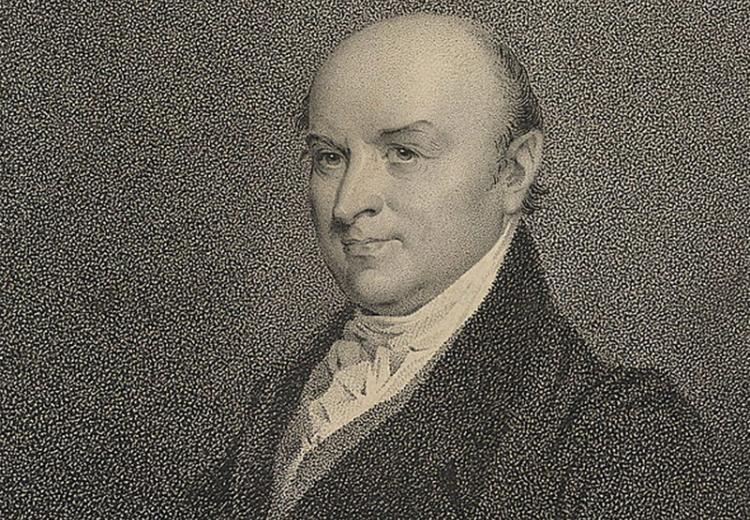
John Quincy Adams played a crucial role in formulating the Monroe Doctrine when he was Monroe's Secretary of State.
Credit: Courtesy of American Memory at the Library of Congress.
In its entry for The Monroe Doctrine (1823), Information USA, an exhibit of the website of the U.S. Department of State, a link from EDSITEment resource Internet Public Library, states:
In Monroe's message to Congress on December 2, 1823, he delivered what we have always called the Monroe Doctrine, although in truth it should have been called the Adams Doctrine.
The writer expresses the opinion that the Monroe Doctrine should have been named after John Quincy Adams to honor his role in its formulation. There is also evidence to indicate that former President Thomas Jefferson strongly influenced President Monroe. Perhaps it should be called the Jefferson Doctrine. Or perhaps the document should have more than one name in its title. In reality, most important government policies such as the Monroe Doctrine are collaborations. However, to hypothesize about the relative contributions of Monroe, Adams, and Jefferson is an interesting exercise requiring an understanding of U.S. diplomacy. There is no "smoking gun," no particular document directly specifying the contributions of one or the other to the Monroe Doctrine. Instead, students should get a sense of the beliefs and methods of each man by studying his role in American diplomatic history and his statements.
Guiding Questions
- In what ways did John Quincy Adams and Thomas Jefferson contribute to the formulation of the Monroe Doctrine?
Learning Objectives
After completing this lesson, students will be able to
- List contributions of James Monroe, John Quincy Adams, and Thomas Jefferson to U.S. diplomacy.
- Cite specific evidence to show the likely contributions of John Quincy Adams and Thomas Jefferson in the formulation of the Monroe Doctrine.
Preparation Instructions
NOTES TO THE TEACHER: You can skip the introduction to this lesson if your class has completed Lesson One: The Monroe Doctrine: U.S. Foreign Affairs (circa 1782-1823) and James Monroe. For an alternative to the activity below, select documents from the list of "The Essential Monroe Doctrine Primary Documents," on pages 16-17 of the Master PDF, to review with students in a directed lesson.
Lesson Activities
Activity 1. Whose Doctrine Was It?
Divide the class into three groups, and assign each group responsibility for arguing on behalf of the role played by one of the three contributors to the Monroe Doctrine. (Alternatively, you could form six groups, with two groups assigned to each contributor.) For each figure, students are provided some background information and excerpts from archival documents to use in finding evidence. To make a compelling case for their contributor, students need to refer to the text of the Monroe Doctrine and statements by or about their assigned figure to support the case for his contributions. Students are encouraged—time permitting—to find additional sources on their own. If time is limited, each group can simply present a summary, offering evidence that its assigned contributor deserves to have his name attached to the Doctrine. After all the groups have presented, discuss the relative contributions of each man. Take suggestions for renaming the Doctrine based on the information presented. One, two, or all three names can be attached to the Doctrine. A show of hands can demonstrate the relative support for each suggestion. Time permiting, the class can hold a more formal debate. All the students should participate in the research and preparation of presentations; however, each group should designate which members will be responsible for each of the four parts of the debate. Suggested guidelines for a 30-minute debate format are provided for the teacher on page 18 of the Master PDF. Adapt the chart, procedures, and allotted times for your own class as desired. The format for the debate follows:
Each group, in turn, presents its opening statement and argument
Each group, in turn, will refute the arguments presented by its opponents
Each group, in turn, will ask questions of the opposing teams; opponents will have up to 30 seconds to respond
Each group, in turn, will present closing statements in which students summarize their positions and cite their strongest arguments.
Classes with six groups should consider combining into three for the debate. NOTE: All of the documents below, unless otherwise specified, are from the EDSITEment-reviewed website American Memory. Students can read the full text of each by clicking on the links below, or groups can use the excerpts from the documents for each contributor provided in the handouts "Documents for James Monroe" on pages 19-23, "Documents for John Quincy Adams" on pages 24-30, and "Documents for Thomas Jefferson" on pages 31-37 of the Master PDF. The excerpts are all in the language of the original. Annotations in parentheses define terms in italics or add information. Some spelling and punctuation has been standardized. Abbreviations with the potential to be confusing have been replaced with full names.
GROUP 1: JAMES MONROE
Questions
- What events in Monroe's background probably influenced the Monroe Doctrine?
- How would you characterize Monroe's philosophy and approach to conducting diplomacy?
Background
- The Monroe Doctrine on The James Monroe Museum and Memorial Library, a link from the EDSITEment resource The American President, which discusses the formulation of the Monroe Doctrine from Monroe's point of view.
- James Monroe Biography on The American Presidency a link from the EDSITEment-reviewed website Internet Public Library.
Documents
- November/December 1817: To Chiefs and Warriors From President
- March 1818: Message to Congress: Permission from Monroe to Jackson to Enter Florida
- March 1818: In response to a House resolution of the previous December, President Madison introduces Secretary Adams's report on the Independence of the Spanish Provinces.
- 1818: Monroe Defends Acquisition of Florida in Acquiring Florida, 1818, by James Monroe on the Gilder Lehrman Institute of American History, an EDSITEment resource.
- March 5, 1821: Monroe's Second Inaugural Address on the EDSITEment-reviewed website The Avalon Project.
- March/April 1822: Political Condition of the Spanish Provinces of South America
- June 2, 1823: James Monroe to Thomas Jefferson
- October 17, 1823: Monroe to Thomas Jefferson
GROUP 2: JOHN QUINCY ADAMS
Questions
- Which events in American diplomacy should be credited to Secretary of State John Quincy Adams?
- What factor(s) influenced Adams's thinking about foreign policy -- keeping the United States neutral so it could develop on its own without the influence of the European powers? Expanding the borders of the United States? Protecting the homeland? Other factors?
- What is characteristic about Adams's approach to diplomacy?
Background
Focus on the role of Secretary of State Adams in James Monroe: Foreign Affairs on the EDSITEment resource The American President. (NOTE: As of this writing, the formatting on the page requires the viewer to scan far down the page to reach the essay
Documents
- 1817: Exchange of Notes 1817: Proclamation (Relative to Naval Forces on the American Lakes), also known as the Rush-Bagot Treaty.
- March 1818: In response to a House resolution of the previous December, President Monroe introduces Secretary Adams's report on the Independence of the Spanish Provinces. This document is included here not for its content but to show that the question of recognizing the revolutionary governments of Spanish America was under consideration for a long time. Interested students can view a series of documents following President Monroe's introduction by Adams and important figures such as Bernardo O'Higgins.
- October 20, 1818: Convention of 1818 between the U.S. and Great Britain, on the EDSITEment-reviewed website The Avalon Project, set the 49th parallel as the U.S.-Canadian border from Minnesota to the Rocky Mountains.
- November 28, 1818: Letter from Secretary of State Adams to Spanish Minister to the United States Don Luis de Onís demonstrates Adams's negotiating style in the months before the Adams-Onís Treaty (the Adams-Onís Treaty was signed on February 22, 1819)
- February 22, 1819: Transcontinental Treaty with Spain signed (ratified February 22, 1821)
- May 20, 1820: Extract of a letter from Minister to Spain John Forsythe to JQ Adams on the Cessation of Florida.
- July 4, 1821: Warning Against the Search for Monsters to Destroy on Documents Relating to American Foreign Policy, a link from the EDSITEment resource World War I Document Archive.
- February 25, 1822: J.Q. Adams to the Russian Minister to the United States
- July 22, 1823: Instructions from Adams to Middleton in Negotiating with Russia
- August 18, 1823: J.Q. Adams on Greek Revolution
- November 7, 1823: John Quincy Adams's Account of the Cabinet Meeting of November 7, 1823 on Documents Relating to American Foreign Policy, a link from World War I Document Archive.
- December 18, 1823: New York Citizens Petition of Sympathy for Greece, demonstrating public sympathy toward revolutionary movements.
- 1824: Convention with Russia, the conclusion of Adams's efforts in negotiating with Russia.
GROUP 3: THOMAS JEFFERSON
Questions
- How did Jefferson's diplomatic experiences as president influence his thinking?
- What factor(s) influenced Jefferson's thinking about foreign policy -- keeping the United States neutral so it could develop on its own without the influence of the European powers? Expanding the borders of the United States? Protecting the homeland? Other factors?
- What was the nature of the advice Jefferson gave Monroe? Did it change over time? How strong was Jefferson's influence?
- How would you characterize Jefferson's philosophy and approach to conducting diplomacy?
Background
- Thomas Jefferson: Foreign Affairs on the EDSITEment-reviewed website The American President.
- Documents
- April 18, 1802: The Affair of Louisiana: To the U.S. Minister to France (ROBERT R. LIVINGSTON), Washington on Thomas Jefferson Digital Archive, a link from The American President.
- January 13, 1803: Crisis on the Mississippi: To the Special Envoy to France (JAMES MONROE), Washington on Thomas Jefferson Digital Archive, a link from The American President.
- August 12, 1803: Jefferson's Expansionism: The Louisiana Purchase: To John C. Breckinridge, Monticello on the University of Virginia Electronic Text Center, a link from Internet Public Library.
- 1816: Jefferson to Monroe on South America
- 1818: Revolt in South America on the University of Virginia Electronic Text Center
- 1820: Independence of Spanish America on the University of Virginia Electronic Text Center
- February 21, 1823: Thomas Jefferson to James Monroe
- April 14, 1823: James Monroe to Thomas Jefferson
- June 2, 1823: James Monroe to Thomas Jefferson
- June 11, 1823: Thomas Jefferson to James Monroe
- August 18, 1823: Monroe to Thomas Jefferson
- October 17, 1823: Monroe to Thomas Jefferson
- October 24, 1823: Thomas Jefferson to James Monroe
- December 1823: James Monroe to Thomas Jefferson (dated "Received December 11")
Assessment
Observe students' understanding of the key concepts during the class debate on the contributions made by Jefferson, Monroe, and Adams. Following the debate, students should be able to respond effectively to the following questions:
- What were the most significant contributions of Thomas Jefferson, James Monroe, and John Quincy Adams to U.S. diplomacy?
- What contributions did Jefferson and Adams make to the formulation of the Monroe Doctrine?
Ask students to (1) write a brief essay, supported by evidence, taking a stand on the most appropriate name for the Monroe Doctrine, or (2) write an essay in which they analyze and evaluate the collective approach used to formulate foreign policy during Monroe's administration.
Extending The Lesson
- Though little noticed when first announced, the Monroe Doctrine has been invoked a number of times. One important example is the (Theodore) Roosevelt Corollary. Below is a list of EDSITEment resources and/or links to use as a starting point for research:
- Henry Cabot Lodge: Corollary to the Monroe Doctrine on Documents Relating to American Foreign Policy, a link from World War I Document Archive.
- Today in History: October 17 on American Memory.
- Teddy Roosevelt's World View on PBS's American Experience, a link from American Memory.
- Learn More About the Monroe Doctrine on Our Documents, a link from Congress Link.
- Students can reflect on American foreign policy, the Monroe Doctrine, and the Instances of Use of United States Forces Abroad, 1798-1993 from the EDSITEment-reviewed website Naval Historical Center.
Selected EDSITEment Websites
- 1818, November 28 From Adams
- Act of the Independence of Peru (July 15, 1821)
- Background on Letter, James Monroe to Thomas Jefferson seeking foreign policy advice, October 17, 1823
- Bernardo O'Higgins to the President of the United States, April 1, 1817
- Convention with Central America
- Don Manuel Torres to the Secretary of State (John Quincy Adams), November 30, 1821
- Independence of the Spanish Provinces
- INDEX TO FOREIGN RELATIONS. VOLUME IV
- Instructions from Adams to Middleton in Negotiating with Russia, July 22, 1823
- Jefferson to James Monroe, February 21, 1823
- Jefferson to James Monroe, June 11, 1823
- Jefferson to James Monroe, June 23, 1823
- Jefferson to Monroe on South America, February 4, 1816
- John Forsythe to JQ Adams on the Cessation of Florida, September 21, 1820
- Message to Congress: Permission from Monroe to Jackson to Enter Florida, March 25, 1818
- Monroe to Thomas Jefferson, April 14, 1823
- Monroe to Thomas Jefferson, August 18, 1823
- Monroe to Thomas Jefferson, December 1823
- Monroe to Thomas Jefferson, December 4, 1823
- Monroe to Thomas Jefferson, June 2, 1823
- Monroe to Thomas Jefferson, October 17, 1823
- New map of South America from the latest authorities. From Samuel Lewis' Atlas, 1817
- Political Condition of the Spanish Provinces of South America (March and April 1822) -- Response to the Resolution of January 30, 1822
- Presenting Colonel Martin Thompson as the authorized deputy or minister of Buenos Ayres, and requesting the protection and assistance of the United States, January 16, 1816
- President Monroe to Congress: Recognition of the Independent States of South America
- Resolution of the House Passed January 30, 1822
- The Republic of Columbia Declared, February 20, 1821 (uniting Columbia, Venezuela, and Ecuador)
- Thomas Jefferson to James Monroe, October 24, 1823 (full text)
- PBS History
- The Library of Congress
American Studies at the University of Virginia
- Declaration of War With Great Britain, 1812
- Adams-Onis Treaty
- Annual Messages of the Presidents
- The Barbary Treaties
- Convention of 1818 between the United States and Great Britain
- Convention of Peace, Amity, Commerce, and Navigation, May 16, 1832
- Exchange of Notes 1817: Proclamation (Relative to Naval Forces on the American Lakes)
- Inaugural Addresses of the Presidents
- The Jay Treaty of 1794
- Louisiana Purchase Treaty
- Monroe Doctrine -- December 2, 1823
- Monroe's Second Inaugural Address
- Preliminary Articles of Peace
- The Proclamation of Neutrality, 1793
- The Quasi War with France, 1791-1800
- Treaty of Ghent
- Treaty of San Ildefonso: Retrocession of Louisiana from Spain to France
- Washington's Farewell Address, 1796
Gilder Lehrman Institute of American History
- Conquering Space (Westward Expansion)
- Defending American Interests in Foreign Affairs
- Embargo of 1807
- The Growth of American Nationalism
- The Louisiana Purchase
- The Presidency of John Adams
- A Second War of Independence
- The War's Significance
- Years of Crisis
- The American Presidency
- The Columbia Encyclopedia: Sixth Edition
- United States Department of State
- University of Virginia Electronic Text Center
- Independence of SPANISH AMERICA: 1820
- James Monroe to Thomas Jefferson, October 17, 1823
- Letter from Jefferson To General Horatio Gates, July 1803
- Revolt In South America
- Thomas Jefferson Digital Archive
- Thomas Jefferson on the Monroe Doctrine
- To John C. Breckinridge Monticello, August 12, 1803
- To the Special Envoy to France (JAMES MONROE) Washington, January 13, 1803
- To the U.S. Minister to France (ROBERT R. LIVINGSTON) Washington, April 18, 1802
The Basics
- Time Required
1-2 class periods
- Subject Areas
- Authors
- MMS (AL)