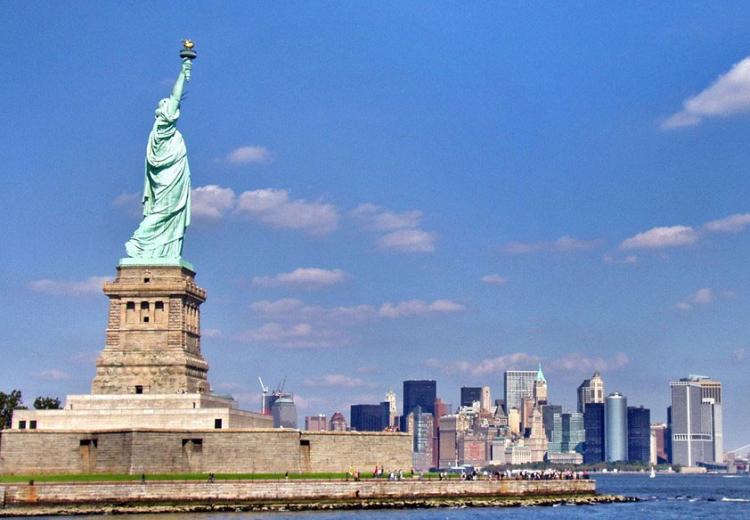

The Statue of Liberty
Credit: Photograph courtesy of the National Park Service
Family stories help teach us who we are, connecting us to a heritage handed down across generations. But when we listen closely, family stories can also be a resource for historical research. They can take us back through memory to the scene of pivotal events or give us a feel for the impact of broad social change, providing a uniquely personal insight into our nation's past.
This lesson plan is designed to help students tap this resource by conducting oral history interviews with family members. Through a series of classroom activities, the lesson introduces students to the riches historians can discover in firsthand recollections; helps them choose a topic and prepare for a productive family interview; provides tips for conducting and recording the interview; and offers suggestions for sharing their family stories in a historical narrative or report.
After completing the lessons in this unit, students will be able to:
1. This lesson plan consists of four learning activities that you can use together as a unit or adapt separately to your curricular needs.
2. Review the suggested activities, then download and duplicate any online materials you will need. If desired, you can bookmark specific web pages so that students can access relevant online materials directly. (See the Resource Links section below for a complete listing of online materials.)
3. EDSITEment provides access to many websites that offer guidelines and suggestions for conducting oral history interviews:
4. There are certain ethical and legal considerations associated with any oral history project. These have been spelled out by the Oral History Association in guidelines frequently updated since 1968, and they are summarized in several of the resources listed above. For educators, the key considerations are:
5. Additional Resources:
This activity introduces students to the experience of capturing oral history through interview recordings accessible at the EDSITEment-reviewed website History Matters.
Divide the class into study groups who will each analyze one of the interviews listed below. Each group will need an Internet-enabled computer and a Web browser equipped with the Real Audio plug-in. Where computer resources are limited, teachers can lead a whole-class discussion of selected interviews. Where classroom computers are not available, teachers can provide students with transcripts of the interviews.
Provide all students with a copy of the Sound Recording Analysis Worksheet available at the EDSITEment-approved website, The Digital Classroom. This worksheet was developed for the analysis of broadcast recordings but can be easily modified to guide student analysis of oral history interviews.
After students have completed their analysis using the worksheet, have each group make a brief class presentation on its interview, then lead a class discussion that focuses on the historical content of each interview and its value as a resource for historical research. For example, you might ask:
Conclude this activity by having students formulate one or two questions they would have asked in the interview they analyzed, basing their questions on factual knowledge of the period or subject discussed in the interview. (For example, a fact-based question to ask in the interview on women's suffrage might be, "What did you and your friends think about Elizabeth Cady Stanton?" A question such as "Did people ever boo when you were speaking?" is not based in factual knowledge of the woman suffrage movement.) Use this exercise to assess students' knowledge of early 20th century American history and as preparation for conducting their own oral history interviews.
Recommended Oral History Interviews from History Matters
This activity guides students step-by-step through the process of preparing for an oral history interview with a family member. Students identify a topic relevant to the life experience of a family member, conduct background research to become informed about their topic, and outline the questions they will ask in their interviews.
Step One: Choosing a Topic
Oral historians typically seek out people who know something about their research topic, but for students planning to interview a family member, the situation is somewhat reversed. They will want to choose a research topic that touches directly on the life experience of a family member. And although some students may have relatives who can recall events from the first half of the 20th century, in most cases this will mean choosing a topic in postwar American history.
Some broad topics in this time period are listed below to provide students with a starting-point for their research project. Those unable to make a choice might go over this list with a parent to find a topic that suits a particular family member. They might learn, for example, that a grand-uncle was active in the Civil Rights Movement, or that a cousin served in the Gulf War. Or the list might suggest a different topic about which one member of the family has plenty to say.
At this stage, students should keep in mind that they are choosing a topic for conversation, not for a research paper. The topic should be broad enough to allow for wide-ranging discussion and a rich variety of memories, yet focused enough to give the interview a shape and direction. Too narrow a topic can turn an interview into an interrogation ("Where were you on the weekend of the Woodstock Festival?"). A more open-ended approach makes room for the unexpected and can lead to real discovery.
Topics in Postwar American History
1950s
The Cold War
The Arms Race
The Space Race
The Civil Rights Movement
Television: Sit-coms, Kid Shows, Sports, & Network News
1960s
Youth Culture & Social Protest
The Women's Movement
The Vietnam War
The Black Power Movement
The Arab-Israeli Conflict
1970s
Watergate
The Energy Crisis
The Environmental Movement
The Malling of America
The Computer Revolution
1980s
The Gulf War
Medical Breakthroughs: AIDS, Organ Transplants, & Genetics
The Collapse of Communism in Europe
Insurgency and Repression in Latin America
The Struggle against Apartheid in South Africa
Step Two: Background Research
Once they have selected a topic, have students conduct background research to become familiar with the basic facts behind the historical episode they plan to talk about. What people, places, and events figure prominently in this chapter of American history? What ideas and assumptions affected the climate of opinion at the time? Such information can help students develop pertinent interview questions and will prepare them both to contextualize the memories shared with them and to pursue lines of inquiry that may arise.
In addition to library resources, such as encyclopedias, chronicles, timelines, and handbooks, students can research their topics using the EDSITEment-approved websites listed below, as well as the EDSITEment search engine, which locates approved resources both on EDSITEment and on other Thinkfinity Partner websites.
EDSITEment Resources on Postwar American History
At the Internet Public Library
At Learner.Org
Conversations With History
Interviews with leading authorities on many aspects of postwar American foreign relations, as well as other social issues.
We Shall Overcome: Historic Places of the Civil Rights Movement
A virtual tour highlighting key events and personalities in the struggle for racial equality.
Step Three: Planning Your Questions
Once they are familiar with their topic, students should be able to set a goal for their interview. What do they hope to find out through the memories their family member will share? This goal can be fairly specific (e.g., How did the family member react to the Watergate scandal and why?) or more general (e.g., What has been the family member's experience with computers over the course of his or her life?). Some students might even have several closely related goals. It is important, however, that students prepare for their interviews with some objective in mind, and frame questions designed to help them achieve it.
Have students state their interview goals in writing and then develop a list of at least ten questions that will help them gather the kind of historical information they are looking for. Remind students of these guidelines for asking effective interview questions:
When they have completed their question lists, have students role-play interviews with one another to test whether their questions are effective and easy to understand. Teachers might also review each student's questions to assess whether they reflect factual knowledge of the topic, a clear objective for the interview, and an awareness of effective questioning methods.
This activity guides students through the process of conducting an oral history interview with a family member by providing a checklist that outlines preparations, documentation procedures, and interview techniques.
Review the checklist with students in class, discussing any points that raise questions. Use this opportunity to arrange for students who do not have access to a tape recorder to borrow one from a classmate. If tape recorders are unavailable to your students, explain that they can still conduct their interviews the old-fashioned way, by taking notes and writing up their family member's responses immediately afterward. Students might also want to experiment with conducting interviews by email, with instant-messaging software, or via webcam.
Provide students with a release form to use at their interviews. See the Sample Release Form included in the American Folklife Center guidebook, Folklife and Fieldwork: A Layman's Introduction to Field Techniques. Include your name, the course name, and your school name on the release form, along with an explanation of this research project.
Have students check off the items on the checklist when they conduct their family member interviews, and assess their completed checklists to determine that all students have obtained a signed release and properly documented their research.
Oral History Interview Checklist
This activity offers suggestions for helping students analyze their interviews with family members and present their findings in the form of an historical narrative or report.
Have students listen to their interviews and produce a summary using their list of questions as a preliminary outline. Encourage students to transcribe key parts of the interview as they listen, stories and statements that are especially revealing or that bring a moment in the past back to life. Students might also listen to their interview a second time using the Sound Recording Analysis Worksheet to gain a more objective viewpoint on their family member's recollections and their own role in shaping the interview.
When students have completed this initial analysis, lead a class discussion designed to help them focus on the relationship between personal experience and what we tend to think of as the impersonal unfolding of historical events. Ask students, for example, to share evidence from their interviews of the impact events can have on individual lives. Some might describe the experience of family members who were directly involved in events like the Civil Rights Movement or the Women's Movement. Others might describe how events altered a family member's life, sending an uncle on to graduate school, for example, during the draft for the Vietnam War, or prompting a grandmother to become vigilant about recycling in response to the Environmental Movement. Events can also have an emotional impact on individuals that may be revealed when family members compare what they thought at the time, about Watergate, for example, and what they think about the event today. And in some lives, events can mark a turning-point, standing as the moment when an individual's personal history became swept up in the historical process and he or she made a choice, for example, to escape a volatile political situation in Latin America or to become an enthusiastic evangelist for personal computers.
Follow up this discussion by helping students explore how individual perspectives mediate our perceptions of the past. Ask them, for example, to compare a family member's recollection of an event with accounts they read while conducting their background research, and invite them to compare how individuals from different families remember the same event, such as the first moon landing or the destruction of the Berlin Wall. Through such comparisons, investigate how an individual's level of engagement may color his or her recollection of specific events, how an aunt who led a psychedelic life during the Sixties, for example, may remember those times much differently than a grandparent who only observed the hippie movement. Investigate also how subsequent events and nostalgia can color memories, leading a cousin, for example, to have a more positive impression of early television shows than most viewers had at the time.
Conclude your discussion by asking students to provide evidence from their interviews of the way oral history can bring us closer to the past, give us a real feeling for the climate of the times, and evidence of the way it can filter our view of the past, turning grays into black and white, assigning minor factors a major importance, under the influence of a lifetime's experience. Use these examples to help students recognize that a historian must balance information gathered through any single oral history interview with information gathered through background research, and information provided in other interviews on the same topic, in order to construct a valid account of the past.
Have students combine their background research and their interviews in this way to construct their own historical narratives or reports. Those who decide to create a narrative will aim to tell their family member's story in his or her own words, using their background research to fill in details and provide historical context. Remind students who choose this option to quote accurately and to indicate which parts of the narrative are direct quotation, indirect quotation, and their own summary.
Students can also use their oral history interviews to write a report on their research topic, developing a thesis based on their interview goals. In this case, they might draw on portions of the interview to vividly illustrate a point in their argument or to cast a new light on the facts of history, one that suggests a new way of understanding what happened and why. Remind students who choose this option also to quote accurately and to document excerpts from their interviews appropriately.
In addition to written narratives and reports, of course, students might share their oral history findings in a class presentation; in a recorded essay modeled on reports like those heard on the National Public Radio programs "This American Life" and "All Things Considered;" in a multimedia computer presentation that combines text, sound, family photos, and images, audio clips, and video clips discovered on the Internet; or in a short story or play that dramatizes a family member's experience in the past.
Additional Resources
Oral History Workshop on the Web
Folklife and Fieldwork: A Layman's Introduction to Field Techniques
Usual Oral History, and the Model Forms
5 class periods