
This lesson focuses on the constitutional arguments for and against the enactment of federal anti-lynching legislation in the early 1920s. Students will participate in a simulation game that enacts a fictitious Senate debate of the Dyer Anti-Lynching Bill. As a result of completing this activity, students will gain a better understanding of the federal system, the legislative process, and the difficulties social justice advocates encountered.
The first phase of the NAACP's anti-lynching campaign was the Republican-led attempt to pass the Dyer Anti-Lynching Bill in 1921-22. In 1921, L.C. Dyer, a Republican Congressman from St. Louis, Missouri, introduced a revised version of his 1918 anti-lynching bill in the House of Representatives. In essence, this bill gave the federal government the authority to punish lynch mobs when the agents of the individual states, that is, the municipal officers, failed, neglected, or refused to provide the victim with equal protection under the law. The municipal officers would be tried in a federal district court. If convicted, they could be fined up to $5,000, incarcerated for a maximum of five years, or both; the county where the lynching occurred was also subjected to a $10,000 fine payable first to the victim's family, if any, second to the parents, if still alive, or finally to the United States Government.
For the next year and a half, the NAACP, in concert with Dyer and other sympathetic Republican legislators, worked in vain to make the bill a law. The bill managed to pass the House of Representatives and get a favorable report from the Senate Judiciary Committee before it was killed by the threat of a Senate filibuster. Although the Southern Democrats in the Senate led the charge against the bill, some Republican Senators, of which William Borah from Idaho was the most prominent, raised serious questions about the bill's constitutionality. Throughout this battle, President Warren Harding paid lip service to the need for a federal anti-lynching bill, but refused to pressure a Republican-controlled Congress to give him one to sign. James Weldon Johnson, the Secretary of the NAACP, and his assistant, Walter White, tried in vain to overcome Borah's constitutional objections and Harding's indecisiveness.
Perhaps more significantly, the bill's failure tarnished the image of the Party of Lincoln within the black community and sounded the "siren song" of a black exodus to the Democratic Party. As James Weldon Johnson put it in November 1922, "The fate of the Anti-Lynching Bill is the culmination of a series of disappointments under the present administration which completely rids the Negro of the old idea that he must now, henceforth and forever more vote the Republican ticket for the sole reason of what the Party did sixty years ago."
When one examines the NAACP's anti-lynching campaign of the 1920s critically, it becomes clear that the congressional debate about the Dyer Bill serves as a window for students to view how Americans in the 1920s understood the federal system. Participants on both sides of this issue articulated interpretations of the Constitution that secondary students need to know in order to comprehend the controversy surrounding the New Deal a decade later.
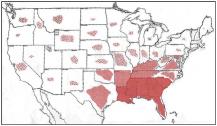
“3436 Blots of Shame on the United States: 1889-1922.” A map prepared for the NAACP in 1922 and published in newspapers. The map graphically details the extent and intensity of lynchings by region and state. |
The proponents of the Dyer Bill formulated a constitutional defense that foreshadowed New Deal liberalism. The federal government, they argued, had an obligation to help its citizens when the individual states were unable or unwilling to do so. They interpreted the Fourteenth Amendment broadly, so its provisions applied to the actions of the mob. As Walter White contended in a final effort to persuade Senators of the constitutionality of the bill in December 1922, "It is not only against the act of killing that the Federal Government seeks to exercise its power through the proposed anti-lynching law but against the act of the mob in arrogating to itself the functions of the State and substituting its actions for the due processes of law guaranteed by the Federal Constitution to every person accused of a crime." Since numerous "eminent legal authorities" concurred with White, the NAACP urged the Senate to allow the Supreme Court to decide questions of constitutionality after the bill was enacted.
The approach the NAACP urged involved, in Senator Borah's words, "the very lowest form of constitutional immorality." In Borah's view, legislators who relegate questions of constitutionality solely to the Supreme Court shirk their ethical responsibilities and endanger our system of government. As a coordinate branch of government, Congress must police itself with some form of internal constitutional review before it enacts legislation. In other words, individual legislators cannot vote for a law, no matter how well intentioned, if they believe it is unconstitutional. Those who do otherwise are, as Borah put it, "the lawless brothers of those who, under more trying circumstances, take the law in their own hands and join the mob."
Of course, this played into the hands of Senate conservatives, especially the Southern Democrats, who objected to the bill because it violated the Tenth Amendment or states' rights. After all, police powers were reserved to the individual states in our federal system. Lynching was murder and the states, which all had anti-lynching laws on the books, were responsible for prosecuting the wrong doers. Better enforcement of existing state legislation, not intrusive federal legislation, was the answer to the lynching problem in the United States. Time and again, the opponents of the anti-lynching laws proudly pointed to Supreme Court decisions, such as The Slaughterhouse Cases, United States v. Cruikshank, and The Civil Rights Cases, which narrowly defined provisions of the Fourteenth Amendment to apply to the actions of the states, not the individuals that comprise them. The case law on the Fourteenth Amendment coupled with a rigid definition of federalism clearly caused the Dyer Bill to fail the test of constitutionality in the minds of conservative Senators.
The students will have to write a brief summary (approximately two or three paragraphs) of the document that includes a short biographical sketch of the document's author.
In order for the simulation game to be successful, the teacher must hold all students accountable for fulfilling their assigned roles; therefore, the teacher needs to evaluate the document summaries and Senate floor speeches before the students deliver them to the rest of the class. This will ensure that the students convey accurate information during the simulation game; it will also help foster a more interactive environment since the students will know based on the teacher's feedback that their answers are acceptable or need some revision. In addition to grading the document summaries and Senate floor speeches, the teacher should try to incorporate questions about the NAACP's anti-lynching campaign into their unit exam or culminating activity about American society in the 1920s.
Have students pay special attention to how the Supreme Court narrowly interpreted the provisions of the Fourteenth Amendment so they applied only to the actions of the states and not the individuals that comprised them.
9-12
3-4 class periods class periods