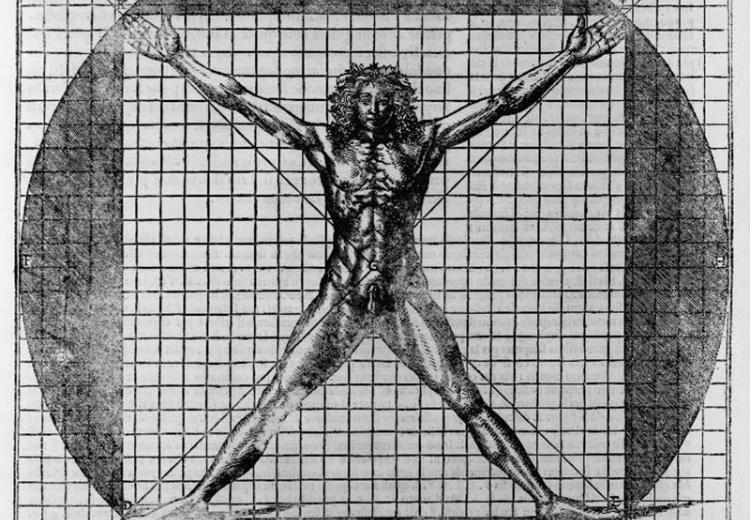

Leonardo da Vinci, "Vitruvian Man." Venice, Galleria dell' Accademia, c. 1485–1490.
Credit: Photo courtesy Luc Viatour / www.Lucnix.be, Wikipedia.
Leonardo da Vinci—one of history’s most imaginative geniuses—was certainly born at the right time and in the right place. The Italian Renaissance was an exciting period of discovery and invention, of exploration and creation.
Students will discover why Leonardo is considered the ultimate Renaissance man. They will learn about his famous notebooks, focusing upon his machines of motion, then zooming in on the flying machines. As a culminating activity, the students will describe how Leonardo epitomizes the Renaissance man, by discussing this remarkable artist and inventor through the amazing variety of his creativity.
Upon completing this unit, students will be able to
Leonardo da Vinci lived during one of the most creative periods in the history of Western Europe—the Renaissance. The rediscovery of the philosophical and scientific treatises of classical Greece and Rome had changed the way scholars and artists thought about the universe. After centuries of domination by the Catholic Church, the focus shifted to the power of reason and the potential of man. The other-worldliness of the Church-dominated medieval period gave way to the eager investigation of this world, leading to a revolution in the realms of art, architecture, technology, engineering, and many fields of science.
Leonardo was a mirror of the age in which he lived. Artist, scientist, engineer, architect, musician and courtier par excellence, he embodied what came to be known as the multi-talented Renaissance Man. Leonardo carefully studied the world around him. He believed that art should clearly reflect the wonders of the natural world. But his works also contained a certain mystery. His Mona Lisa, perhaps the world’s most famous painting, is known for her haunting smile. Leonardo was also fascinated by the way things worked. He mused endlessly about cause and effect, filling thousands of pages of his famous notebooks with sketches and commentary dealing with subjects as diverse as the anatomy of a horse and the design of a hydraulic pump.
Leonardo was also intrigued about the possibilities of locomotion, and he designed a number of machines that would enable man to get around faster. Most of all, he was fascinated by the possibilities of human flight. He captured birds and studied their feathers and skeletal systems to puzzle out the secrets of aerodynamics. He studied the flow of water in rivers and streams as well as the effects of tides in order to better understand wind currents. Using what he observed in nature, he designed some very ingenious flying machines.
For additional background information on Leonardo and the Renaissance, go to European Renaissance Art available through EDSITEment-reviewed resource Metropolitan Museum of Art. Review the timelines and thematic essays for general information about the period.
Review the materials students will explore on the Boston Museum of Science site and Leonardo’s Studio from the BBC program on Leonardo.
Review the activities in this lesson plan. Locate and bookmark suggested materials and useful websites. Download and print out documents you plan to use and duplicate copies as necessary for student viewing.
Explain that the term “Renaissance man” refers to someone who has a mastery of many fields. Then mention that Leonardo is known as the Renaissance man par excellence. Students will explore Leonardo’s world and decide for themselves what his greatest contributions to Renaissance society were. But you may want first to introduce students to Leonardo the artist, and one of the most famous paintings with which they are probably already somewhat familiar.
Although he was multi-talented, Leonardo is best known today for his paintings. And certainly the most famous of his paintings is the Mona Lisa.
For information on the famous painting have students go to the BBC’s website on Leonardo and read the brief summary on the painting.
Ask students to view other images from Leonardo’s painting in the BBC Picture Gallery. What elements in the painting do they associate with what they have learned about Leonardo? (Some examples include his use of sfumato, chiaroscuro, and aerial perspective.)
Now that the students have made the acquaintance of Leonardo da Vinci, the artist, they’re ready to do a bit of research to enrich their understanding of this great man and the age in which he lived.
Leonardo da Vinci was easily swept up with the spirit of his times. Drawn to many arenas of creative activity, he plunged into one project after another, with some amazing results. Have students read a brief overview of Leonardo’s Life at Renaissance Man from the Museum of Science in Boston, available through the EDSITEment-reviewed resource Museum of the History of Science.
Divide the class into groups, assigning each group a specific area in which Leonardo made a significant contribution to his time and to society in general—in aerodymanics, anatomy, architecture, botany, engineering, mathematics, optics, ornithology, painting, or physics. Each group will explore its assigned area and then make a case for Leonardo’s great contribution to Renaissance knowledge in that particular area.
Contributions:
For a quick overview of the range of Leonardo’s talents, have students access Explore Leonardo’s Studio available through the Museum of the History of Science at Oxford, England.
Instruct the students, working in groups, to locate the 12 objects in the interactive picture and to learn all they can about each one.
When they have finished, have each group note the information that fits the area they have been assigned for Leonardo. They can do this on the chart in the PDF, Leonardo da Vinci: Renaissance Man.
From boyhood, Leonardo da Vinci was a keen observer of the world around him. As a young man, he began the habit of writing notes about his observations. In 1482 he began a wide variety of scientific research projects ranging from botany and anatomy to military engineering and geography. He jotted down his ideas and theories, accompanied by detailed sketches, in a collection of notebooks. In time, he would fill thousands of pages.
Leonardo’s notebooks are not easy reading. The subject matter changes abruptly as a new idea popped into his mind. He also used strange spellings and abbreviations. And most intriguing, the pages are most easily read if they are held up to a mirror!
For a more detailed look at Leonardo’s manuscripts, students can virtually leaf through portions of Leonardo’s notebooks, as a class, or again in groups.
Students can also view another Leonardo codex, available from the Ambrosiana Library in Milan. The text is in Italian, but students should focus on the images to gather clues to determine Leonardo’s area of expertise as indicated by his drawings.
Leonardo spent a good deal of time thinking about how people could get around faster—on the earth, in the water, and even in the air. After studying the anatomies of certain wild creatures and tinkering around with mechanisms like gears and pulleys, he came up with some designs for vehicles that were way ahead of his time.
For this lesson you can keep students in the assigned groups or, if taught in a science class, you may want to assign each student a drawing and have them consider the kind of knowledge necessary to invent the machine depicted. For example, for students choosing engineering as Leonardo’s greatest accomplishment, have them
But it was the possibility of human flight that particularly intrigued Leonardo. Since very ancient times, man had dreamed of being able to fly. Leonardo came up with a number of ways that, he thought, just might work.
Given the times in which he lived, Leonardo’s designs for flying machines were amazing! Although there were some major flaws, his designs would eventually evolve into the modern airplanes of today. Leonardo never actually built any models of his designs, but you can view some that have been made in modern times.
Have each student group, or as individuals, present evidence that Leonardo should be recognized for his contribution to a particular field, and why this would make him an important member of Renaissance society.
As a whole class, assign students to write an essay on what constitutes a Renaissance man (or woman) and why Leonardo epitomizes the true Renaissance man. The essays should cover the range of Leonardo’s creative talents and acknowledge the impact of his ideas and designs on future society as well.
One of Leonardo’s most unusual (and modernistic) inventions was a humanoid robot. To find out more about this project, access Leonardo’s Robot available through Museum of the History of Science.
4-7 class periods