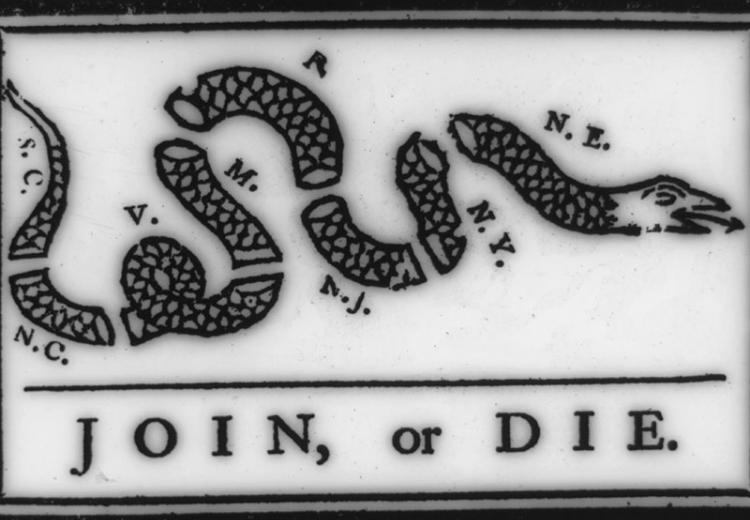
Benjamin Franklin’s Join or Die cartoon, one of the first visual sources of colonial union (and disunion), appeared in the May 9, 1754 issue of the Pennsylvania Gazette.
Credit: Library of Congress.
By the mid-18th century, British colonial settlements on the east coast of North America had become part of a vast colonial empire, abutting other European empires and territories occupied by numerous Native American tribes and confederations. The British had developed their empire for political and economic purposes over the previous century, seeking to protect the colonies from European rivals and profit from their colonies’ products and commerce. Around 1750 many nations and peoples were engaged in a contest for North America – and some of these competing parties came together at the Albany Conference that took place in June and July of 1754 under British auspices.
In this lesson students will examine the various visions of three active agents in the creation and management of Great Britain’s empire in North America – British colonial leaders and administrators, North American British colonists, and Native Americans. Students will assess the identities and relationships of these groups in the context of the Albany Conference of 1754, where they came together at the behest of British officials seeking greater colonial unity in anticipation of a war with France for North American territory.
By the middle of the eighteenth century, the British Empire in North America was in the midst of great change once again. The British and other European powers with imperial ambitions competed on the North American continent while they fought with one another in Europe and Asia. Native American nations became entangled in those European colonial wars that were waged in North America; they also fought to keep their homelands clear of European settlers. The growing prosperity of the colonists in general and the colonial merchants in particular led to the tightening of British colonial regulations and helped to make the often diverging interests of imperial administrators and British settlers more obvious. The contest with the French and the increased number of settlers moved the British administration away from its earlier view of North America as a collection of commercial outposts. The Board of Trade and its American officials described North America as a continental dominion: “a hierarchical imperial state with political and military, as well as economic interests,” according to historian Timothy Shannon. These developments opened up the issue of how various groups sought to resolve their identity in the expanding British empire in North America. What form should the empire take? What did it mean to be a Briton? What rights (and obligations) did a colonist have?
When the British organized a conference in Albany in the summer of 1754, many of these different groups and competing agendas rose to the fore, but few envisioned the world wide war that would soon begin. The Albany Congress laid bare the colonists’ and Indians’ reactions to the expansion of British power in North America. By 1754 Britain’s grip on the colonies appeared to have broken down: French troops had occupied the Ohio valley, cutting off British access to the continent’s interior while the Indians in New York had declared the Covenant chain alliance broken, threatening a full-scale collapse of Indian trade and diplomacy in northern colonies. Colonial governments, long accustomed to managing on their own, resisted cooperation with each other or with the Crown. Colonial administrators called for greater authority to handle this crisis of the empire, taking advantage of various recent plans for reform of colonial organization in Great Britain and the colonies. The Board of Trade in London called for a meeting in Albany. The Congress was actually two meetings: an Indian treaty conference and an intercolonial conference. Various colonial politicians including New York’s Governor James DeLancey and Pennsylvania’s Benjamin Franklin were just as busy scheming at the meeting for their own particular interests as addressing a broader imperial vision for the British. While women, enslaved people, and indentured servants were numerous among the colonists, their perspectives were not present at the Albany Congress.
The conference produced as its enduring legacy, the Albany Plan of Union, which can be found on the EDSITEment-reviewed Avalon Project. This lesson in its largest sense asks students to develop a clearer understanding of the context of Britain’s imperial expansion and the Albany Congress. The idea of colonial union broached by Franklin and others at the Congress had its origin not in a native or colonial penchant for political federation but rather in a long struggle to define the limits of local and centralized power in the British Atlantic empire.
Teachers might also review some of the following primary and secondary sources related to the Albany Congress:
1. On Albany Congress:
2. Benjamin Franklin, colonial politician and Pennsylvania’s representative
3. Native Americans
4. Aftermath: The Seven Years’ War
Alibamon Mingow, Chocatow, 1765, "Another Race of White Men Come Amongst Us": Native American Views as British Replace the French in the Lower Mississippi Valley, 1765,” as British replace French in the lower Mississippi Valley. From EDSITEment-reviewed History Matters.
1. Throughout this unit, students will read and analyze a variety of primary documents. The following materials from EDSITEment resources may be useful to teachers seeking expert advice on the use of primary documents:
2. Download or bookmark the various sources and documents the students will use in the lesson. These include:
1. Have students examine the following historic map by Emanuel Bowen, A Map of the British American Plantations, 1754, a link on Digital History. Look at the Northeast and the area marked Iroquois:
Then compare the Bowen 1754 map with a present day map that shows the English colonies in 1750 on EDSITEment’s Learner.org.
How do the borders differ on this map?
2. Students should be familiar with the role of the British North American colonies in the eighteenth century. Either refer them to their textbooks or ask them to read the following: Darla Davis, “To Tax or Not to Tax: 2/5 Out of Sight, Out of Mind,” a link on History Matters.
3. Now divide students into three groups to read the documents below (one document for each group) to provide evidence to help them answer the questions posed below. Each one of these documents is directly or indirectly a product of the Albany Congress, which can be introduced to students with this short explanation of the Congress from the Constitution Society, linked from the Internet Public Library.
Ask the students to annotate evidence such as phrases, words, and concepts that help them to answer the following questions for each set of documents.
Each document will have one sample annotation for a key concept, such as empire, to facilitate the student’s work.
The documents are:
4. Students in each one of the three groups should read their annotations to the entire class.
5. In a whole class discussion have the students delineate the three authors’ political ideas and their visions of the future of the colonies. How are the three authors’ ideas and visions similar and how are they different, complimentary or antagonistic? The discussion should focus on the following questions:
6. Based on their reading of the three documents and the discussion, the teacher and students should construct a chart of the goals of three of the groups of people who occupied and contested the North American continent in the mid-18th century: British colonial officials and interest groups, North American colonists, and Native Americans (sample chart).
First, the teacher should ask students to discuss the colonists and the Native Americans. Construct a three-column chart with these questions:
The class should go through the questions above again in a discussion about the British officials and the colonists. Return to the chart.
Ask students to write an essay that responds to the following questions, being sure to use evidence from at least three different primary sources (along with secondary sources) to support their answers:
How did British colonial leaders, North American British colonial leaders, and Native Americans want to organize North American society in general and relationships among themselves in particular? On what specific issues did they agree and disagree? What were the principal reasons for disagreement?
1. Have students explore the connection between the visions presented at the Albany Congress and the events that followed it.
How and why did the differing visions of the groups in question produce the outcomes that they did? (the breakdown of the Covenant Chain, the ‘failure’ of the Albany Plan, the French and Indian War, the road to the American Revolution?
You could use direct them to some of the sources listed in the Background Information for Teachers – Step Four.
2. Students could explore the role of Franklin as colonial politician (and other roles) at 300 Years of Ben Franklin linked from the EDSITEment website. They might also look at Franklin, The Pragmatic Innovator, on the American Memory website. One important source is the first American political cartoon, Franklin’s "Join or Die" cartoon that appeared in the May 9, 1754 issue of the Pennsylvania Gazette. The image is one of the first visual sources for colonial union (and disunion)
3. Students could research the role of William Johnson, preeminent cultural mediator in the northeast between Europeans and Native Americans, using the following sources:
One possible question for students to ponder would be: How did Johnson mediate between the interests of the British Empire and the Native Americans?
4. Students could analyze the engraving “British Resentment or the French fairly Coopt at Louisbourg” which was commissioned in 1755 by Parliament to show British resentment at the return of Louisburg (linked from IPL) to France – one of the first prints to show the American colonies as part of the British state with depictions of British soldiers, French fops, and American Indians. It is a tableau of empire.
9-12
2-3 class periods