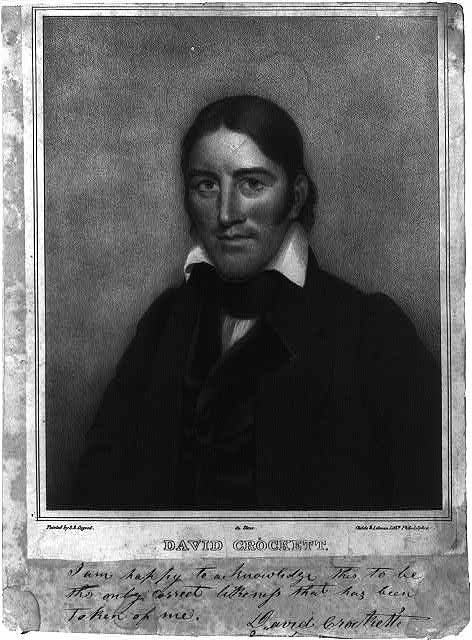

Davy Crockett
Born on a mountaintop in Tennessee,
Greenest state in the land of the free,
Raised in the woods so he knew every tree,
Kilt him a b'ar when he was only 3.
Davy, Davy Crockett, King of the wild frontier!
From "The Ballad of Davy Crockett"
Theme of the Disneyland TV Production of "Davy Crockett"
"First make sure you're right, then go ahead."
Attributed to David Crockett
He was born in a small cabin beside the banks of the Nolichucky River, not on a mountaintop. He did not kill a bear when he was only three. He was called David, not Davy. But his achievements and fictional exploits have entered the American imagination. It's difficult to distinguish what he did and said from what has been attributed to him; it's also difficult to discuss the influence of the frontier on the American temperament without reference to David Crockett.
In 1834, A Narrative of the Life of David Crockett, of the State of Tennessee was published, followed by a series of popular pamphlets known as Crockett Almanacs. David Crockett, United States Representative from Tennessee, already a folk hero in his home state, became one of the most famous men in the nation. More than a century later, in 1955, "The Ballad of Davy Crockett" was the No. 1 song in the nation for weeks, and sales of Davy Crockett items grossed $100 million. Coonskin caps were worn not only by young boys, but also by adults like presidential candidate Estes Kefauver, who sported one at numerous public appearances.
What made David Crockett one of the most famous Americans during his lifetime? Why did his legend still loom so large in the American imagination long after his death? In what ways is he typical of the heroes of the tall tales that sprang up during the first half of the 19th century?
Ask your students how many have heard of Davy Crockett. What "facts" do they know about him? How many of the students believe Crockett was a real historical figure? How many believe he is a fictional character?
The students will now hear or read a tall tale about Davy Crockett from a source such as American Tall Tales by Adrien Stoutenburg (Puffin Books, 1976). (Note: Several print resources on tall tales are listed under Other Resources at the end of this unit.) Next, lead the students in a discussion of the "tall" elements of the story and the elements that might have a basis in history. Based on the discussion, create a chart of characteristic elements of tall tales that students will use to analyze other tall tales they encounter in this unit.
Share with the students "Big Fred Tells a Tall Tale," which you will find on the EDSITEment resource American Memory by searching for the title. "Big Fred" is a tall tale from a more recent era—the title indicates it is a tall tale, and Big Fred even mentions Paul Bunyan, another tall tale hero. What literary elements are present in this tale? What exaggerations are present in the tale? What historical elements (labor disputes, for example) do students notice? Do the students consider Big Fred's story a tall tale? As students discuss these stories, refine the list of tall tale characteristics as desired.
David Crockett lived. He was born in Tennessee; he did die at the Alamo. But even these events have become clouded by the tales, some created by the publicity machine of an ambitious man, that have grown up around Crockett, a potential candidate for President of the United States.
Share with the class the brief biography of Crockett's life available on Encarta, a link from the EDSITEment resource The Internet Public Library. If desired, use a map to help the class understand the location of Tennessee, Alabama (where Crockett fought in the War of 1812), Washington, D.C., and Texas.
Discuss briefly what elements in Crockett's life made him a good candidate to be the hero of tall tales in the 1830s.
The students have read a tall tale about Crockett and they have read a brief biography. Now, they can analyze some documents to determine whether they are factual, tall tales or a combination of the two. Working in small groups with a strong reader in each, students should attempt to answer the following about each document:
Select from these or other documents related to Crockett:
Death of David Crockett.
CAPTAIN REUBEN M. POTTER, U. S. A., writing to correct some statements in an account of the fall of the Alamo that appeared in an article on General Sam Houston, in THE CENTURY for August, 1884, states that Crockett was killed by a bullet shot while at his post on the outworks of the fort, and was one of the first to fall. Captain Potter says that the story of Crockett being captured with a gun barrel in one hand, and a huge knife in the other, and a semicircle of dead Mexicans about him is pure fiction. Bowie was ill at the time of the fight, and was found murdered in his bed; and a single bullet-hole in the forehead of Travis tells the whole tale of his death. Nothing else, he adds, can be known.
When it came to my turn, I squared myself, and turning to the prime shot, I gave him a knowing nod, by way of showing my confidence; and says I, "Look out for the bull's eye, stranger." I blazed away, and I wish I may be shot if I didn't miss the target. They examined it all over, and could find neither hair nor hide of my bullet, and pronounced it a dead miss; when says I, "Stand aside and let me look, and I warrant you I get on the right trail of the critter." They stood aside, and I examined the bull's eye pretty particular, and at length cried out, "Here it is; there is no snakes if it ha'n't followed the very track of the other." They said it was utterly impossible, but I insisted on their searching the hole, and I agreed to be stuck up as a mark myself, if they did not find two bullets there. They searched for my satisfaction, and sure enough it all come out just as I had told them; for I had picked up a bullet that had been fired, and stuck it deep into the hole, without any one perceiving it.(Note: It is difficult to know how much Crockett contributed to works attributed to him. Your students should probably be aware of this. According to American Studies at the University of Virginia:
A Narrative of the Life of David Crockett (1834) is the autobiography most likely to be the actual work of Crockett; edited by Thomas Chilton. Much of the other writing attributed to Crockett was actually penned by ghost writers (presumably due to Crockett's lack of formal education) and was approved by Crockett before publication.)
"When the day of election approaches, visit your constituents far and wide. Treat liberally, and drink freely, in order to rise in their estimation though you fall in your own. True, you may be called a drunken dog by some of the clean shirt and silk stocking gentry, but the real rough necks will style you a jovial fellow, their votes are certain, and frequently, count double. Do all you can to appear to advantage in the eyes of the women. That's easily done—you have but to kiss and slabber their children, wipe their noses, and pat them on the head; this cannot fail to please their mothers, and you may rely on your business being done in that quarter.
"Promise all that is asked," said I, "and more if you can think of up thing. Offer to build a bridge or a church, to divide a county, create a batch of new offices, make a turnpike, or anything they like. Promises cost nothing, therefore deny nobody who has a vote or sufficient influence to obtain one.
"Get up on all occasions, and sometimes on no occasion at all, and make long-winded speeches, though composed of nothing else than wind."
"Mr. Crockett presented a petition of three citizens of the Cherokee nation of Indians, by W. S. Coodey, their agent, stating, that, by treaties concluded between the United States and said Cherokee nation in the years 1817 and 1819, the petitioners became entitled each to a reservation of 640 acres of land, that they were forcibly dispossessed of said land by white men, that they sued out writs of ejectment, but from poverty were unable to prosecute said writs, and that judgments have gone against them by default; and praying indemnity for their losses from the Government of the United States."H.R. Journal—Monday, January 31, 1831, available on the EDSITEment resource American Memory by searching for the entry date.
"Mr. Crockett presented a petition of inhabitants of the Western District of Tennessee, praying that the lands lying within said district, and belonging to the United States, may be given for the support of common schools within the same."H.R. Journal—January 19, 1829, available on the EDSITEment resource American Memory by searching for the entry date.
When I got up the hill, I found I had passed the dogs; and so I turned and went to them. I found, when I got there, they had treed the bear in a large forked poplar, and it was setting in the fork.
I could see the lump, but not plain enough to shoot with any certainty, as there was no moonlight; and so I set in to hunting for some dry brush to make me a light; but I could find none, though I could find that the ground was torn mightily to pieces by the cracks.
At last I thought I could shoot by guess, and kill him; so I pointed as near the lump as I could, and fired away. But the bear didn't come, he only clomb up higher, and got out on a limb, which helped me to see him better. I now loaded up again and fired, but this time he didn't move at all. I commenced loading for a third fire, but the first thing I knowed, the bear was down among my dogs, and they were fighting all around me. I had my big butcher in my belt, and I had a pair of dressed buckskin breeches on. So I took out my knife, and stood, determined, if he should get hold of me, to defend myself in the best way I could.
"At last, at the hour of ten, the outer wall was gained. Then, room by room was taken with slaughter incredible. There were fourteen Americans in the hospital. They fired their rifles and pistols from their pallets with such deadly aim that Milagros turned a cannon… upon them… at the entrance of the door they left forty dead Mexicans."
"Ah Señor, Señor! tell me no more. My heart can not endure it."
"Mi madre," answered Isabel, "we must hear it all. Without it, one cannot learn to hate Santa Anna sufficiently"; and her small, white teeth snapped savagely, as she touched the hand of Lopez with an imperative "Proceed."
"Colonel Bowie was helpless in bed. Two Mexican officers fired at him, and one ran forward to stab him ere he died. The dying man caught his murderer by the hair of his head, and plunged his knife into his heart. They went to judgment at the same moment."
"I am glad of it! Glad of it! The American would say to the Almighty: 'Thou gavest me life, and thou gavest me freedom; freedom, that is the nobler gift of the two. This man robbed me of both.' And God is just. The Judge of the whole earth will do right."
"At noon, only six of the one hundred and eighty-three were left alive. They were surrounded by Castrillon and his soldiers. Xavier says his general was penetrated with admiration for these heroes. He spoke sympathizingly to Crockett, who stood in an angle of the fort, with his shattered rifle in his right hand, and his massive knife… in his left. His face was gashed, his white hair crimson with blood; but a score of Mexicans, dead and dying, were around him. At his side was Travis, but so exhausted that he was scarcely alive.
"Castrillon could not kill these heroes. He asked their lives of Santa Anna, who stood with a scowling, savage face in this last citadel of his foes. For answer, he turned to the men around him, and said, with a malignant emphasis: 'Fire!' It was the last volley. Of the defenders of the Alamo, not one is left."
Okay, a million is an exaggeration, but there are many tall tales the class can analyze for comparison. Stories about Johnny Appleseed or Mike Fink (such as those from the Stoutenberg book) are fruitful for comparison because both Appleseed (nee John Chapman) and Fink were historical figures. It would also be productive to share a tale about a completely fictional character such as Pecos Bill. Use the opportunity to help students distinguish between the fictional and factual elements of these tales. Though Pecos Bill probably did not exist as an individual, elements of his tales (e.g., the Grand Canyon, barbed wire) are real.
Why would an author want such fantastical stories to contain factual elements?
Read one or more additional tall tales to the class or have the students read them. What similarities do students note between these tales and the Crockett tale? Does the class need to refine its list of tall tale characteristics?
Do the students enjoy these stories? Why?
The unit culminates with students creating their own tall tales in either a pioneer or contemporary setting. A tale set in the present time would be particularly relevant, as we are presently undergoing rapid technological change, and an era about which many people are nostalgic—the 20th century—has recently ended.
Begin by having the students summarize what they have learned. What are the qualities of a tall tale? What various reasons might people have had for wanting to "stretch the truth" in tales of historical figures of the frontier? What values do the tales reflect? Is the class list of tall tale qualities sufficiently refined?
Tell the students that though there are many tall tales, there is still room to expand the genre, particularly with tales about the late 20th century and tales with female heroes.
Students interested in writing a tale about the late 20th century should think about what is being lost in the technological revolution our country is undergoing. What ways of life or occupations are threatened by modern technology? For example, today, factory work is threatened by automation and the change to an information society. (There is a precedent: Joe Magarac, a tall tale hero, was a steelworker.) However, most sports figures would not work as tall tale heroes because their profession is not similarly threatened.
Students interested in creating tales with female heroes from history can read about some courageous women in the article Heroic Women, available on RootsWeb, a link from the EDSITEment-reviewed website Women of the West Museum.
Using a rubric designed with your specific goals will help your students understand what is expected and how they are being evaluated. Go over the standards as students get started.
To be completely effective, a rubric should be designed for your class with your curriculum, the students' skill level and the specific assignment in mind. The following is provided as a sample to use when designing your own. Click here to download the rubric in rich-text format.
| Name: _________ | Exemplary | Very Good | Satisfactory | Needs Revision |
|---|---|---|---|---|
| Date: __________ | ||||
| Structure: | ||||
| Beginning: | Reader becomes involved in the story and wants to read on. | Good attempt at getting the reader's attention. | Situation clear to reader, some attempt to get reader's attention. | Situation unclear to reader after the opening. |
| Middle: | Character learns and grows as intriguing problems are dealt with though not necessarily solved. | Character works to solve problems using his/her skills. | Character is given problems to solve but solutions may be pat. | Character is given insufficient problems to solve. |
| End: | Seamless ending helps the author communicate the theme of wishing for "the good old days." | Ending smoothly completes the tale. | Sufficient ending. | Insufficient or no clear ending. |
| Content:Includes some, or all, of the following: Exaggeration, character's origin, hero with extraordinary abilities, actual locations, historic characters, humor, theme of wishing for "the good old days." | Tall tale content helps the writer create an intriguing tall tale hero and sheds light on the predicament and personality of the main character. | Tall tale content is woven smoothly into the plot. | Sufficient tall tale content. | Insufficient tall tale content. |
| Grammar, Usage, Mechanics, Spelling | Virtually perfect GUMS. | Some errors, but mostly in areas not emphasized in class lessons. | Some errors in areas covered in class lessons, but not enough to prevent understanding. | Errors interfere with the ability of the nomination to be understood. |
| Overall Evaluation: | Comments: | |||
NOTE: Exemplary papers have all the positive characteristics of very good papers.
During the time period when students are working on their stories, read tall tales aloud to the class every day. Encourage students to share their stories when they are completed. Consider ways to publish your students' original stories—from creating a tall tale book for distribution in your school to posting them on your school's website or submitting them to other children's websites.
Websites:
Books:
Book on Cassette:
Video: