

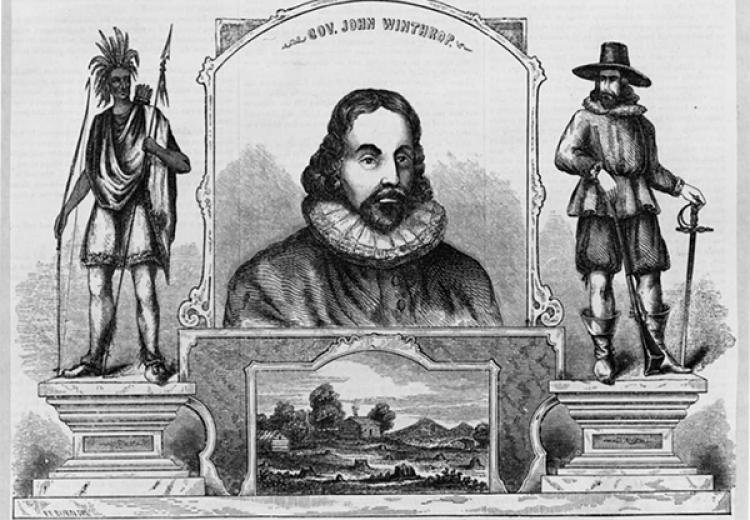
John Winthrop wrote his "General Observations for the Plantation of New England" in the summer of 1629 to justify the Puritan migration to New England.
Credit: Images courtesy of American Memory, Library of Congress.
John Winthrop’s “Model of Christian Charity” was delivered as a sermon aboard the Arabella, as the Puritans approached their destination of Massachusetts Bay in 1630. It is a powerful speech outlining some key tenets of the Puritans’ beliefs, as well as Winthrop’s ideas of what the Puritans needed to do to build a successful community in the land they were entering. The speech, often referred to by its “City upon a Hill” metaphor, spells out his vision of the society they hoped to create and how they must act if they were to succeed in the eyes of God. The sermon sought to inspire and to motivate the Puritans by pointing out the distance between an ideal community and their real-world situation. It is a speech that American political leaders still quote.
Why would a large number of English people leave their country and homes for a destination far across the Atlantic Ocean? From 1630 to 1641, approximately 13,000 Puritans left England for New England – WHY? They followed the migration of the Pilgrims, who arrived in 1620, and an advance party of Puritans who went to Salem in 1629. But the first mass exodus occurred in 1630, when Governor John Winthrop led a fleet of ships from England to found the Massachusetts Bay Colony. King Charles I issued a charter to the Massachusetts Bay Company that would serve as the colony’s constitution, in other words, its framework of government.
This lesson focuses on the content of Winthrop’s speech and how it illuminates the Puritans’ beliefs, goals, and programs. It requires a close reading of a difficult text – but one that yields significant benefits to those who persist and analyze it closely.
The term “New England” was first used by John Smith before any English settlers had even reached North America. The Puritans’ charter from King Charles, creating a typical joint stock company, was issued to the Massachusetts Bay Company, although it did not specify the exact location in North America where they would settle. It was used as the colony’s framework of government when they arrived in 1630, with different parts of the large fleet settling in several small communities around Massachusetts Bay. Each town was formed around a minister and a magistrate. The Puritans had demanded a fuller reformation of the Church of England. They were being persecuted for their beliefs and their protests against the corruption they saw in the Church of England. By fleeing England they hoped to escape the divine wrath that threatened England and create the kind of churches that God demanded in New England.
The Puritans did not arrive in an unoccupied world, however. The Algonquian population had recently suffered a dramatic decline caused by their contact with Europeans and their deadly contagious diseases, which led to a series of epidemics among the natives. The English, accustomed to seeing signs of God’s providence throughout the natural world, viewed this plague as evidence of God’s desire for them to build their colony.
Winthrop’s speech addresses the dual concerns of the Puritans as they arrive in this new land: the fact that they have left England for a potentially hostile, unwelcoming terrain, and the idea that they are there to fulfill their mission. He is exhorting his fellow Puritans to see their endeavor as a tremendous opportunity to do God’s work, while cautioning them of the dangers with which it is fraught. As such, it is a good example of the Puritans’ notion of a covenant, or agreement, of how they believed they must act in order to retain God’s favor and be successful in their work.
New England settlers also intended to continue their familiar agricultural practices; soon they were raising livestock and grains. They established a successful trade in grain, lumber, and fish with the West Indies. Their economic success ultimately led to a shifting of emphasis away from religious matters and greater attention to material prosperity – much to Winthrop’s dismay. Economic considerations, religious persecution in England, and the desire to establish a community based on their religious ideals were important motivating forces in the settlement of New England.
The following materials from EDSITEment reviewed websites will be useful to teachers for background information on the Puritans, their beliefs, their reasons for migrating to New England, and related topics.
Download or bookmark one version of Winthrop’s speech, depending on how much experience your students have reading 17th century documents and their reading level:
The activity below is explained using the last two paragraphs of the full version, referencing paragraphs and punctuation that ARE NOT in the shorter, original version.
In addition, teachers may want to use the National Archives’ document analysis worksheet that is linked through the EDSITEment-reviewed American Memory site, which prompts students to seek important information in the primary source and consider questions of audience, motivation, etc.
(If you have more than one class session for this topic include this lesson, if not, proceed directly to “Winthrop's Speech” below):
Scholars believe that John Winthrop authored this document as a justification for the colonization of New England as well as a defense against those who criticized the Puritans’ departure from England.
Students should read “Reasons for the Plantation in New England” [available for students as a worksheet in .pdf format] to determine the major reasons Puritans wanted to immigrate to New England. Working in groups, students should analyze the different reasons, and the “objections” that are raised and answered. They should present their findings to the class. After the class has a list of reasons, they should work together to prioritize the list, rating the reasons for emigrating from “most” to “least” important.
"It will be a service to the Church of great consequence to carry the Gospel into those parts of the world, to help on the fullness of the coming of the Gentiles, and to raise a bulwark against the kingdom of AnteChrist, which the Jesuits labor to rear up in those parts."
At this point the teacher might want to raise questions with the students about whether Winthrop was speaking for the Puritan leadership or expressing ideas held by common Puritans.
"All other Churches of Europe are brought to desolation, and our sins, for which the Lord begins already to frown upon us and to cut us short, do threaten evil times to be coming upon us, and who knows, but that God hath provided this place to be a refuge for many whom he means to save out of the general calamity, and seeing the Church hath no place left to fly into but the wilderness, what better work can there be, than to go and provide tabernacles and food for her when she be restored".
(if you have only one period, do this activity)
"Now the only way to avoid this shipwreck, and to provide for our posterity, is to follow the counsel of Micah, to do justly, to love mercy, to walk humbly with our God."
Have students read the annotation available in the document (available as launchpad and as a PDF to clarify their understanding and to serve as a model for their annotation writing.
Working in pairs, students develop a dialogue between two Puritans who are debating the merits of going to the New World, one of whom is in favor of the venture, the other against. They use the evidence presented in the “reasons for going” as well as the “objections, their answers and resolutions” to underscore the main arguments on both sides.
Ideally, the big question that students will pose is: How did things actually work out for the Puritans? Lessons could be developed to look at other documents/images that illustrate the course of the Puritan’s “model” society. They could examine Winthrop’s journals and the subsequent development of Massachusetts. In addition, they could examine key dissenters: Roger Williams and Anne Hutchinson. See the following EDSITEment-reviewed websites for possible resources:
Stronger students who are interested in the Puritans and Winthrop’s language should be encouraged to tackle the full speech.
This is a full-text version (it is LONG) in the original language (from the EDSITEment-reviewed History Matters. The language has been somewhat updated, making for easier reading)
Have students LISTEN to part of the speech and explain how it differs hearing it, rather than reading it. This is a link to a portion of the sermon read aloud, by Reverend Peter J. Gomes, Harvard University Divinity School professor, linked through the EDSITEment-reviewed Internet Public Library.
9-12
1-2 class periods