

Ladybug
Credit: Photograph courtesy of the National Archives
A giant firefly:
that way, this way, that way, this --
and it passes by.
--Issa (1762-1826)
Haiku show us the world in a water drop, providing a tiny lens through which to glimpse the miracle and mystery of life. Combining close observation with a moment of reflection, this simple yet highly sophisticated form of poetry can help sharpen students' response to language and enhance their powers of self-expression. In this lesson, students learn the rules and conventions of haiku, study examples by Japanese masters, and create haiku of their own.
After completing this lesson, students will be able to
Provide students with a selection of haiku from those available through the AskAsia website at Haiku by Basho and Haiku for People. Include both classic and contemporary examples in your selection. Have members of the class read each poem aloud and ask students to comment on similarities they notice among them. Through this discussion, help students recognize that haiku are:
Drawing on the students' observations, provide an outline of the main rules for writing haiku, as explained at Haiku by Basho and Haiku for People:
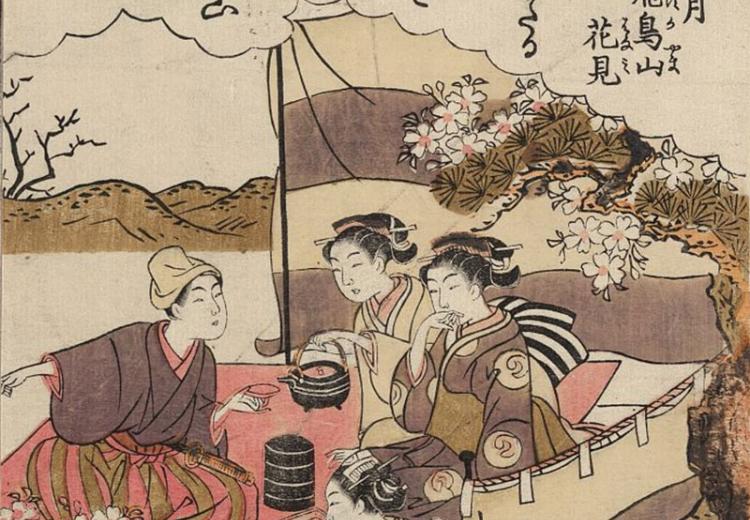
This same point of view can be found in traditional Japanese woodblock prints (called "ukiyo-e"), which distill a timeless beauty from the constantly shifting scene of daily life. For examples of woodblock prints that can help students visualize the world of haiku, visit the Ukiyo-e Museum of the Nagoya Broadcast Network, accessible through the Teaching (and Learning) About Japan website on EDSITEment, and browse the galleries called "Rain and Snow" and "A Sense of Journey." In each gallery, click on the small image to view a larger version with an interpretative caption, then click the larger version to view the image at maximum size.
As preparation for writing their own haiku, have students brainstorm a glossary of words they might use, based on the rules and conventions of this form of poetry. Begin with the kigo, asking students to suggest words that would give a clue to the season in their haiku (e.g., robin, crocus, Final Four for spring; heatwave, fireworks, grasshopper for summer; jack-o-lantern, harvest, kickoff for autumn; icicle, hibernate, holly for winter). Then, for each season, have students choose an occurrence that might be the subject of a haiku and brainstorm descriptive language that would help a reader visualize that scene. List their suggestions on the chalkboard and use this exercise to help students generate ideas for their haiku, encouraging them to see the range of possibilities beyond a description of nature.
Finally, have students write a haiku based on some personal experience, using at least one of the words they have brainstormed in class. Pair students to edit and suggest improvements to one another's work, then hold an in-class haiku festival, having each student read his or her poem aloud. Although haiku do not traditionally have titles, you might invite students to suggest titles for their classmates' work as a way to encourage discussion and a constructive atmosphere of critical response.
Invite students to submit their haiku to the Mainichi Daily News, which publishes a monthly selection of "Haiku in English" from writers around the world. At the paper's English-language website, students can also read a wide selection of present-day haiku, including recent winners of the Mainichi Haiku Contest. Haiku can be submitted by email to mdn@mainichi.co.jp.
Students can also create their own haiku anthology on your school website, or display their haiku in a hallway or on a library bulletin board. For art teachers, haiku can provide a springboard for lessons on print-making or for creating works based on nature subjects
4-5 class periods