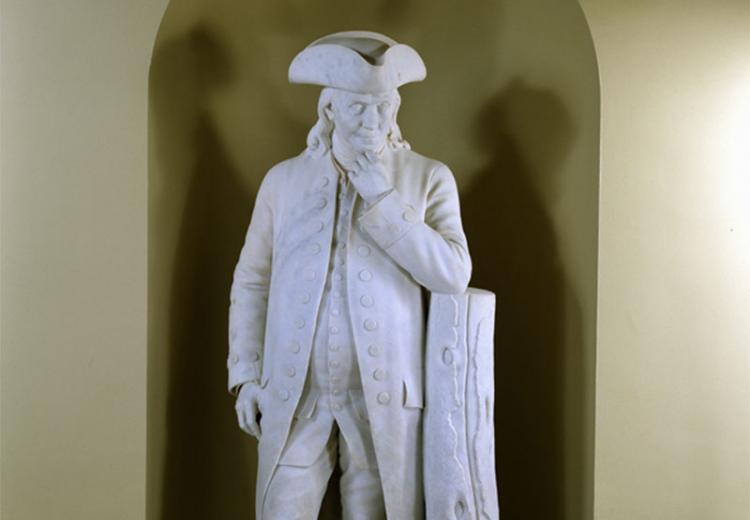

Hiram Powers (1805–1873), Benjamin Franklin, 1862. Marble, height 97 1/2 in., width 34 7/8 in., depth 21 5/8 in. (247.7 x 88.6 x 54.9 cm.).
Credit: U.S. Senate Collection.
Since our Time is reduced to a Standard, and the Bullion of the Day minted out into Hours, the Industrious know how to employ every Piece of Time to a real Advantage in their different Professions: And he that is prodigal of his Hours, is, in Effect, a Squanderer of Money.”
—Benjamin Franklin, Poor Richard Improved, 1751
Ben Franklin, a signer of the Declaration of Independence and of the Constitution was also a philanthropist, a community leader, patriot, and Founding Father. This lesson plan exemplifies all our new country fought for in the Revolutionary War: individualism, democracy, community, patriotism, scientific inquiry and invention, and the rights of “We the People.”
"Franklin, elder statesman of the Revolution and oldest signer of both the Declaration of Independence and the Constitution, sat on the committee that drafted the Declaration, attended the Constitutional Convention, and distinguished himself as a diplomat. But he was a self-made man and self-educated intellectual colossus whose interests far transcended politics. He won international renown as a printer, publisher, author, philosopher, scientist, inventor, and philanthropist. On both sides of the Atlantic, he mingled with the social elite, whom he impressed with his sagacity, wit, and zest for life."
These EDSITEment Lesson Plans relate to Benjamin Franklin's role as a founding father of the United States:
Thinkfinity and EDSITEment have a wealth of resources about Franklin in his many different "hats" or roles. These include:
In 1858 Congress commissioned one of America's most respected artists, Hiram Powers, to create statues of Benjamin Franklin and Thomas Jefferson for the Capitol. Although born in Vermont, Powers' studio was in Florence, Italy, where he had ready access to skilled assistants, inspirational Classical art, and models — important resources that were in short supply in his homeland at that time. Learn more about Powers and his statue of Benjamin Franklin at the United States Senate Web site and Picturing America's Educators Resource Book, image 4b.
When Powers created his larger-than-life sculpture of Franklin, democratic leaders were often depicted in the Neoclassical style, which was based on Classical Roman and Greek art. Powers sculpted busts of George Washington and Andrew Jackson draped in Classical togas in this accepted Neoclassical style. But despite criticism, he chose to sculpt his statues of Franklin and Jefferson realistically in clothing they would have worn in the 1700's.
Although Powers depicted Franklin in contemporary clothes, much about the statue reminds us of ancient Greek and Roman sculptures. Like Classical art, it's carved of white marble and Franklin stands in a traditional contrapposto pose with most of his weight resting on one foot and the opposite leg bent. This creates a gentle curve extending through the midline of the figure. Folds in his coat and the vertical gash in the tree stump echo the curve of this center line, giving the sculpture unity. Franklin also rests one arm on the tree trunk. Roman sculptures that were modeled after original Greek works in bronze often included a support such as a tree trunk or shield to keep the fragile piece of marble stable.
Portraits can reveal personality and details about a person and their life as well as how artists feel and think about their subject. By resting Franklin's chin in his hand and showing a downward gaze, Powers suggests that Franklin is a thinker. The jagged line that scars the tree trunk represents a lightning strike and reminds us that Franklin's experiments with electricity made him an international celebrity and a respected scientist. Franklin's acceptance into Europe's scientific community eventually helped open doors of European courts to him as an American statesman.
Franklin wears the plain clothes of an 18th-century American citizen rather than the frilly European court dress of his day. Powers chose this type of dress very carefully, even having Franklin's actual garments sent to him in Italy so that he could copy them in detail. The artist wanted to use fashion to reinforce the concept that all citizens are equal before the law in a democracy. He also was careful to show how these garments would actually behave. The creases in the coat suggest its weight, while wrinkles in Franklin's hose show their texture and the way they would sag during wear. Franklin's hair also hangs in long loose curls in the manner of the 18th century.
These EDSITEment lesson plans also deal with portraits that reveal character:
Students may learn about Benjamin Franklin and his roles or "hats" by completing and discussing the Look and Think worksheet (Answer Key provided). These will help them observe, analyze, and appreciate the many aspects of Powers' statue of Franklin. After reading the reproducible biography of Franklin, students may create hats illustrating some of the many roles that Franklin played in his life—statesman, politician, scientist, father, community activist, printer, publisher, writer, and inventor. Worksheets and directions for creating hats are included.
Make copies of the: Look and Think worksheet, Benjamin Franklin biography, Directions for The Many Hats of Ben Franklin. *See note in Activity 3. Materials needed: Colored markers and copy or drawing paper, Optional paper hat-making supplies such as scissors, glue, colored papers.
Observation: Have students carefully observe Hiram Powers' Benjamin Franklin. They may complete the Look and Think worksheet to guide them in their analysis of this work of art. In this worksheet students compare Franklin's dress to today's clothing as well as to that worn in ancient Greece and Rome.
Class discussion: Use either activities in the Picturing America Educators Resource Book, 4b, or the Look and Think worksheet as a springboard for a class discussion of the art. (See the answer key for the Look and Think worksheet.)
Have students read the biography of Ben Franklin provided in the lesson. Because the biography is a bit long, you may want to stop and pause after each section and summarize what you have read in one or two sentences. This helps students pare down information and remember key ideas.
Students may actually make paper hats that symbolize Benjamin Franklin's "hats" or roles. These hats may be as simple as large tissue paper sheets set on a student's head and fastened around the brow with a masking tape headband or folded paper hats as pictured on a number of Internet sites. Students may attach found and cut-paper objects to their hats to represent the role that they are symbolizing. Encourage students to describe and write about the symbolism in their hats. See Make an Artrageous Hat, Paper Hat, or How to Make Paper Hats.
3 class periods