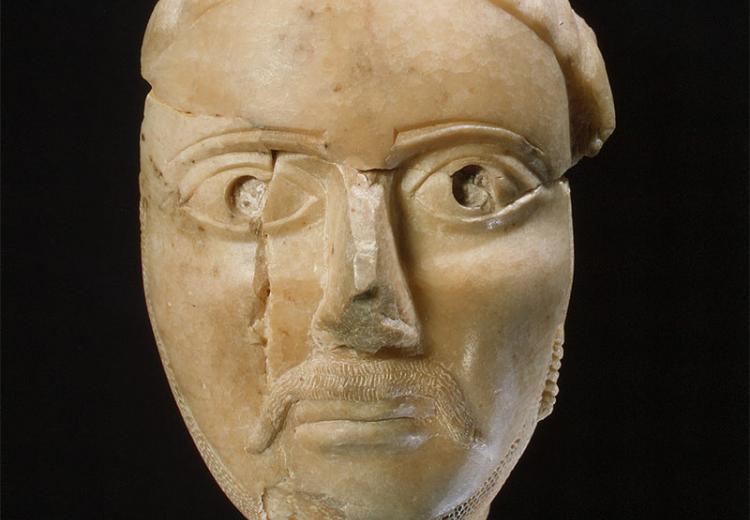

Southern Arabia, Alabaster (gypsum); H. 9.4 in. (24 cm) Purchase, Mr. and Mrs. Nathaniel Spear, Jr. Gift, 1982 (1982.317.1)
Credit: Metropolitan Museum of Art
The Bedouins of ancient Arabia and Persia made poetry a conversational art form. Several poetic forms developed from the participatory nature of tribal poetry. Today in most Arabic cultures, you may still experience public storytelling and spontaneous poetry challenges in the streets. The art of turning a rhyme into sly verbal sparring is considered a mark of intelligence and a badge of honor.
The ghazal (pronounced "guzzle") is an intricate pre-Islamic poetic form that is thought to have developed through the practice of poetic challenges. It is a series of couplets, called shers, no more than a dozen or so, which are related, but not connecting in a narrative pattern. The first couplet, or matla, has a rhyme pattern, kaafiyaa, preceding a single word or short phrase refrain, radif, at the end of each line. Thereafter, every couplet shows a pattern wherein the first line doesn't rhyme, but the second line ends in the kaafiyaa and the radif. Finally, the last couplet, the maqta, contains the takhallis, the poet's name or pen-name.
This complex structure requires careful insights and an understanding of irony and word-play. It dates to pre-Islamic times, yet remains current, forming the lyrical base of much popular music in India, Iraq, and Iran. Students will enjoy discovering the rules of ghazal writing through observation and inference.
After completing this lesson, students will be able to:
Review some general information on poetic form:
To become familiar with the terms and the form of a ghazal, read "What is a Ghazal?", an essay by Abhay Avachat, available through the EDSITEment-reviewed resource Academy of American Poets.
American poet Agha Shahid Ali also explains the ghazal succinctly as follows:
A poem of five to fifteen couplets. The name rhymes with "guzzle."
No enjambment between couplets. Think of each couplet as a separate poem, in which the first line serves the function of the octave of a Petrarchan sonnet and the second line the sestet-that is, there must be a turn, or volta, between lines 1 and 2 of each couplet. Thus, certain kinds of enjambments would not work even WITHIN the couplets, the kind that would lead to a caesura in line 2. One must have a sense that line 2 is amplifying line 1, turning things around, surprising us.
Once again, ABSOLUTELY no enjambment between couplets-each couplet must be like a precious stone that can shine even when plucked from the necklace though it certainly has greater luster in its setting.
What links these couplets is a strict formal scheme. (I am speaking of the canonical form of the ghazal, shaped by the Persians in, I believe, the twelfth century.) This is how it works: The entire ghazal employs the same rhyme and refrain. The rhyme must always immediately precede the refrain. If the rhyme is merely buried somewhere in the line, that will have its charm, of course, but it would not lead to the wonderful pleasure of IMMEDIATE recognition which is central to the ghazal, The refrain may be a word or phrase.
Each line must be of the same length (inclusive of the rhyme and refrain). In Urdu and Persian, all the lines are usually in the same meter and have the same metrical length. So establish some system-metrical or syllabic-for maintaining consistency in line lengths.
The last couplet may be (and usually is) a signature couplet in which the poet may invoke his/her name in the first, second, or third person.
The scheme of rhyme and refrain occurs in BOTH lines of the first couplet (that is how one learns what the scheme is), and then in only the second line of every succeeding couplet (that is, the first line of every succeeding couplet has no restrictions other than to maintain the syllabic or metrical length.
There is an epigrammatic terseness in the ghazal, but with immense lyricism, evocation, sorrow, heartbreak, wit. What defines the ghazal is a constant longing.
This is what a ghazal looks like:
Couplet one:
______________________________rhyme A + refrain
Couplet Two, Three, & so on:
____________________________________________
______________________________rhyme A + refrain
Here are some opening and concluding couplets of mine:
Example A:
I say That, after all, is the trick of it all
When suddenly you say "Arabic of it all."
For Shahid too the night went quickly as it came.
After that, O Friend, came the music of it all.
Example B:
What will suffice for a true love knot? Even the rain?
But he has bought grief's lottery, bought even the rain.
They've found the knife that killed you, but whose prints are these?
No one has such small hands, Shahid, not even the rain.
Example C:
Suspended in the garden, Time, bit by bit, shines-
As you lean over this page, late and alone, it shines.
Mark how Shahid returns your very words to you.
It's when the heart, still unbriefed, but briefly literature, shines.
Example D:
Where are you now? Who lies beneath your spell tonight
Before you agonize him in farewell tonight?
And I, Shahid, only am escaped to tell thee-
God sobs in my arms. Call me Ishmael tonight.
Select the following three sample ghazals, available through the EDSITEment-reviewed resource Academy of American Poets from a search on ghazal:
Ask students: Does COW rhyme with FEW or BURROW? Does CAKE rhyme with ATTACK? Yet in Arabic poetry, these might be acceptable rhymes. Explain that Arabic poetry uses a different form of rhyme than English poetry. Arabic poets sometimes need only end in the same syllable or even letter to call it rhyme. Distribute the first ghazal. Ask students to read aloud, taking turns for each couplet, so that the discreteness of the shers is emphasized through voice, while the radif is made obvious because each speaker ends in the same word. Have students identify the patterns they observe and devise a rhyme scheme formula through inference. They should arrive at the formula defined by Ali:
Couplet one:
______________________________rhyme A + refrain
Couplet Two, Three, & so on:
____________________________________________
______________________________rhyme A + refrain
Distribute the other two ghazals and ask them to determine whether the authors have observed the basic "rhyming rules" of the ghazal.
After having completed Lesson One, ask students to observe similarities among the three ghazals; they should conclude that the first couplet always repeats the rhyme and refrain, and the last couplet always contains the poet's name. Tell them the poet is referred to as the Shayar, the equivalent of the speaker. Have them speculate as to why this structure was established. After students finish sharing responses, explain if necessary that ancient Arabic poetry was often a public event and group participation was encouraged. One theory states that the opening couplet repeats the rhyme and refrain so that everyone participating hears it twice and is certain of it; the final stanza belongs to the poet who initiated the ghazal, so he claims credit after so many have participated by including his name.
Next, encourage students to discuss the relationship of the couplets within a ghazal. They should conclude that the couplets do not link, but are related only by the pattern of rhyme and refrain, as well as a theme. Advanced students may notice also that there is no enjambment between lines, and that the second line seems to respond to the first line.
Have the students combine their learnings to arrive at a final, single-sentence definition of the ghazal as a series of independent couplets, of which the first couplet defines the rhyme pattern and refrain in both lines, remaining couplets use the same rhyme and refrain in the second line, and the last couplet mentions the author's name.
Note: this activity can be enriched for World Literature classes by teaching them the Arabic terms and having them use these terms in their discussion.
In groups of four, students compose a ghazal in a round-robin activity for a total of thirteen shers, beginning and ending with the same Shayar, or poet. The group should decide on the radif, but the Shayar can choose the kaafiyaa. Allow thirty minutes for composition; then have groups read their ghazal round robin.
9-12
3 class periods