


The Namesake by Willa Cather
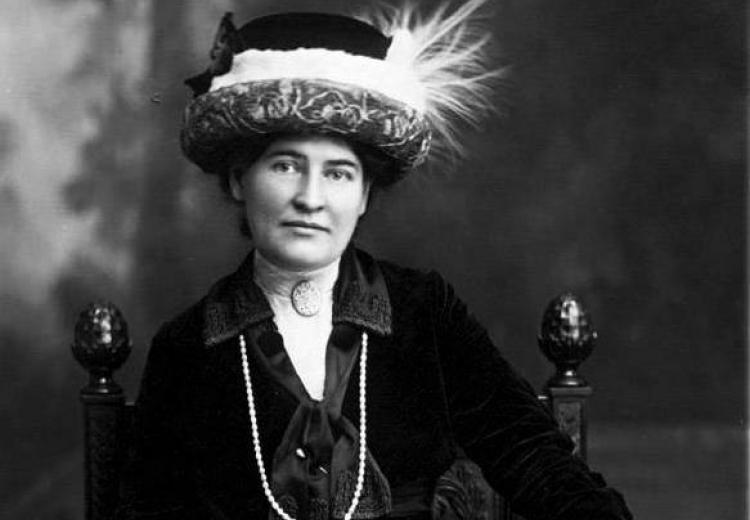
Willa Cather, 1912

Directions: This Launchpad, adapted from the What So Proudly We Hail curriculum, provides background materials and discussion questions to enhance your reading and understanding of Willa Cather’s short story “The Namesake.” After reading the story, you can click on the videos to hear editors Amy A. Kass, Leon R. Kass, and Diana Schaub converse with guest host William Schambra (Hudson Institute) about the story. These videos are meant to raise additional questions and enhance discussion, not replace it.
About the Author
Willa Sibert Cather (1873–1947), one of America’s most beloved authors, is best known for her novels depicting the lives of people who settled the American heartland and the Southwest: O Pioneers!, My Ántonia, A Lost Lady, and Death Comes for the Archbishop. Her life, like her writing, crisscrossed much of the United States. Born in Virginia, Cather grew up in Nebraska and graduated from the University of Nebraska. She then worked as a journalist and as a teacher in Pittsburgh, Pennsylvania. Cather moved to New York City in 1906, where she lived the rest of her life, but making long visits back to the Midwest, the Southwest, and California.
Scholars have suggested that “The Namesake” (written in 1907) has autobiographical significance: Cather’s maternal uncle, William Seibert Boak, died in the Civil War (fighting for the Confederacy), and Cather gave herself a slightly modified version of his middle name. In her short story, however, the death of a (Union) Civil War hero becomes the centerpiece of a moving exploration of American national identity and of the vocation of the artist in relation to his country. Like her protagonist, Lyon Hartwell, Cather visited Paris and fell in love with it. She also greatly admired Henry James, who wrote extensively about America while living as an expatriate abroad. But unlike both Hartwell and James, Cather always made America her home.
Plot Summary
The story is set in Paris at the turn of the twentieth century. Seven young American students, aspiring artists all, gather in the apartment-studio of the great sculptor Lyon Hartwell on a night when one of them, Charles Bentley, is departing for home. On display in the apartment, ready for casting, is Hartwell’s latest statue, The Color Sergeant, a work that draws the admiration—and envy—of the students. Challenged by Bentley to explain where he gets “the heat to make an idea like that carry,” Hartwell tells his young admirers the story of his own American “homecoming.”
Born in Italy to a self-exiled (and ultimately unsuccessful) American artist, Hartwell was orphaned by age fourteen. Still, he remained in Rome, studying sculpture, attempting to fulfill his father’s artistic ambitions for him, and then moved to Paris to continue his artistic career. Ten years later, on the cusp of some success, he was, he says, “almost for the first time … confronted by a duty which was not my pleasure”: his grandfather died, leaving his father’s ailing maiden sister alone.
Intending to bring his aunt back to Paris, Hartwell journeyed to his father’s and grandfather’s birthplace—and to America—for the first time. Quickly realizing that it would be cruel to uproot his aunt, he remained in America for two years, waiting for her illness to run its course. There he languished, feeling utterly estranged from the old family home and from the bustling industrial world encroaching upon it. One thing only touched him: the portrait of his “boy uncle,” his father’s half-brother and his namesake. The uncle’s face reminded him of his “father transformed and glorified; his hesitant discontent drowned in a kind of triumph.” Determined to learn the source of his young uncle’s radiance, he tracked down the story of Lyon’s enlistment at age fifteen, his rise to color sergeant of his regiment, and his tragic death in a charge the next year, both arms dismembered but covered by the Federal flag he had been carrying.
Hartwell found no further clues about his uncle until Memorial Day, when his aunt, who seemed to live for this occasion, insisted that he retrieve the American flag stored in the attic and run it up the flagstaff, which was located in the garden beside a locust tree his young uncle had planted.
While searching in the attic, Hartwell discovered a trunk with his “own” name, Lyon, on it. Later that same night, he returned to open the trunk and find many of his uncle’s things, among which was his uncle’s copy of Virgil’s Aeneid.* On the front flyleaf, Hartwell noted the boyish hand with which his uncle had written his name. On the back flyleaf of the book, however, Lyon had drawn the federal flag, initialed and dated 1862, the year before his enlistment. Above this he had also written the first two lines of Francis Scott Key’s poem, “The Star Spangled Banner.”
“I seemed … at last to have known him,” Hartwell said, “in that careless, unconscious moment … as he was then.”
Hartwell spent the rest of the dark and ominous night of Memorial Day sitting in the garden next to the locust tree, the flag, barely visible, but continuing to flap overhead. There he experienced, he said, “the feeling that artists know when we, rarely, achieve truth in our work; the feeling of union with some great force, of purpose and security, of being glad that we have lived.” Sitting in the garden until dawn, he felt, for the first time “the pull of race and blood and kindred, and felt beating within me things that had not begun with me.” He concluded with an image of his rebirth as an American, rooted in the American soil.
When Hartwell finished his personal story, his young admirers sat in silence. Bentley’s cab then arrived to start him on his voyage home to America.
Thinking About the Text
The story raises many interesting questions about its main character, and especially about his identity as an American and as an artist.
Hartwell in Paris
- How does Lyon Hartwell appear to his young American admirers, and why? They are identified as coming from particular parts of the United States; he is identified as being rather “from America … ocean to ocean.” What does that suggest about him?
- Why does the usually reticent sculptor choose this occasion to tell his story?
- What is his answer to Bentley’s claim that it is only because Hartwell is not an American that he can look so clearly and movingly at American subjects?
- WATCH: Describe Lyon Hartwell. How does Lyon Hartwell appear to his young American admirers, and why?
Hartwell’s Journey to America
- Why is Lyon Hartwell so attracted by the portrait of his namesake?
- What is the significance of his discoveries inside his uncle’s marked-up copy of Virgil’s Aeneid? What does he learn about his namesake? Does the first line of Virgil’s Aeneid—“Of arms and the man I sing”—shed any light on this?
- What happens to Hartwell on the night of Memorial Day? What does he learn about himself?
- What does Hartwell mean when he says that the experience of that night gave him “the same feeling that artists know when we, rarely, achieve truth in our work; the feeling of union with some great force, of purpose and security, of being glad that we have lived”?
- What does Harwell mean when he says, “I felt the pull of race and blood and kindred and felt beating within me things that had not begun with me”?
- What does Hartwell mean when he says, “[I]t was as if the earth under my feet had grasped and rooted me, and was pouring its essence into me”?
- What is the role of the flag in his process of self-discovery?
- WATCH: Why is Lyon Hartwell so attracted by the portrait of his namesake?
- WATCH: What happens to Hartwell on the night of Memorial Day? What does he learn about himself?
Hartwell’s American Identity
- Why, after his moment of self-discovery and of his link with his namesake and with America, does Lyon Hartwell return to live and work in Paris? Is it true, as some have argued, that he chose art and fame over life and country?
- How American, really, is Hartwell?
- WATCH: Why does Lyon Hartwell return to live and work in Paris?
Hartwell as Artist
- What picture of America—and presented in what manner and spirit—does Hartwell offer in his statues?
- Compare the sculpture (and the portrait) of The Color Sergeant with the story of the actual life and death of its subject, as Hartwell comes to know it. Which is more truthful? Who does a better job in conveying the truth about “The Namesake”, Hartwell or Cather?
- What is responsible for Hartwell’s artistic success (in contrast with his father’s)? What is the answer to the question Bentley poses near the beginning of the story: “Where in the world does he get the heat to make an idea like that carry”?
- Compare Hartwell as artist to Virgil as poet and Cather as writer: Do they make their subjects, or do their subjects make them? What is the relationship between the artist and his subject?
- WATCH: What picture of America—and presented in what manner and spirit—does Hartwell offer in his statues?
The Title
- What is the meaning of the title? Who or what is a “namesake”? What is implied in carrying another person’s name? In living “for the sake of the name”?
- When Hartwell memorializes his namesake in The Color Sergeant, does he do honor to the name, even though he does not name him in the sculpture’s title? Assuming that sculptor Hartwell’s own name appears on the statue, is he gaining a name for himself by exploiting that of his uncle?
- Is it perhaps Cather, rather than Hartwell, who makes clear that both “namesakes” are needed if each one is to receive the honor (the name) that he deserves?
- WATCH: What is the meaning of the title? Who or what is a “namesake”?
Thinking with the Story
The plot of the story invites attention to several large themes, among them the nature and basis of American identity, the relation of art (and stories) to American identity, and the meaning and importance of the American flag.
American Identity
-
America is said, rightly, to be a nation founded not on ties of blood and soil, but on ideas and ideals. What then is the role of ties to land and ancestors for American identity? In the past? Today?
- Can an American living abroad be an American citizen in the full sense? Is living within the United States sufficient to make us American citizens in the full sense?
- On what does your own identity and citizenship as an American really rest?
Art, Stories, and American Identity
- What is the role of art (Hartwell’s statues) and stories (Cather’s “The Namesake”) in creating and sustaining American identity? How do art and stories speak to us in ways that other media do not?
- Does devotion to art require some detachment and distance from one’s civic identity and activity? Are artists as artists doing something important for citizenship?
- What is the relation between art or literature and national memory?
The Flag
- What is a flag? What is special about the meaning of the American flag?
- What role can or should the flag play in creating national identity?
- How important to America are its national symbols?
- What feelings and thoughts does the American flag arouse in you?
- WATCH: What role does the flag play in Hartwell’s process of self-discovery?
*A Latin epic poem that tells the legendary story of Aeneas, a Trojan who left the ruins of Troy and traveled to Italy, where he became the founder of Rome