


The Growing Crisis of Sectionalism in Antebellum America: A House Dividing
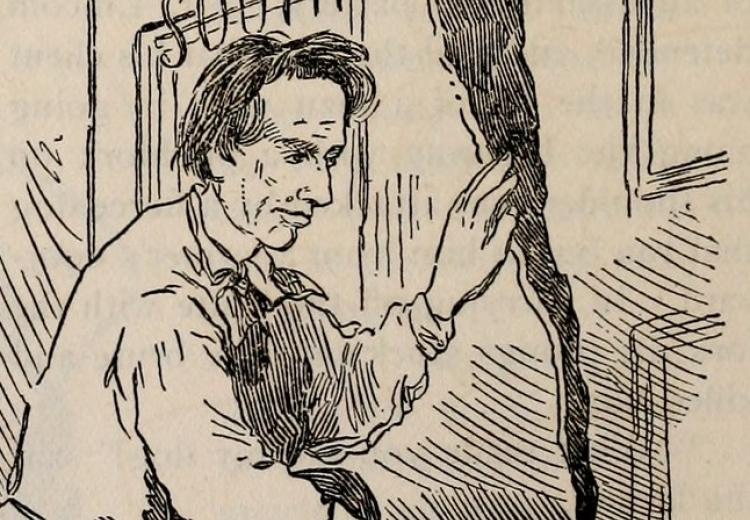
"The New Cabinetmaker" was printed on February 2, 1861.
"Our political problem now is 'Can we, as a nation, continue together permanently—forever—half slave, and half free?' The problem is too mighty for me. May God, in his mercy, superintend the solution."
—Abraham Lincoln to George Robertson, August 15, 1855
In this unit, students will trace the development of sectionalism in the United States as it was driven by the growing dependence upon, and defense of, Black slavery in the southern states. Initially seen as contrary to freedom but tolerated in order to produce the U.S. Constitution, by the 1830s the "peculiar institution" found advocates who saw it as a "positive good." Its expansion into Missouri, southern outrage over federal tariffs, and westward expansion into new territory produced a volatile and persistent debate over slavery that increasingly threatened to divide the American union. By 1860, the nation found an old Democratic Party split over the right to extend slavery into federal territory, and a new Republican Party nominating an anti-slavery, though not abolitionist, president. When Abraham Lincoln's election produced no national consensus to settle the matter of slavery's future, a southern "secession" sealed the fate of the Union.
What characterized the debates over American slavery and the power of the federal government for the first half of the 19th century? How did regional economies and political events produce a widening split between free and slaveholding states in antebellum America? Who were the key figures and what were their arguments regarding the legitimacy of slavery and the proper role of the national government in resolving its future in the American republic? This unit of study will equip students to answer these questions through the use of interactive maps, primary texts, and comparative biographies.
Guiding Questions
How did the Missouri Compromise of 1820 and the Nullification Crisis a decade later illustrate the widening divide between northern and southern states?
What were the leading arguments against slavery in the antebellum era and why did slaveholders defend the "peculiar institution"?
Were Abraham Lincoln's political views unique by comparison with defenders of immediate abolition, popular sovereignty, and national slavery?
What did the Election of 1860 mean for sectionalism and national politics?
Learning Objectives
Use maps of the 1820 Missouri Compromise and the 1854 Kansas-Nebraska Act to understand political and economic changes in the U.S. and why those changes provoked a debate over the expansion of slavery in America.
Examine the arguments forwarded by opponents and defenders of slavery.
Analyze the economic arguments used within the debate regarding slavery.
Examine Lincoln's moral beliefs led him to the conclusion that Congress should use its authority to restrict slavery from the territories.
Analyze the reasons given for and against the morality and legitimacy of slavery under the U.S. Constitution.
Analyze the platforms of the political parties during the 1860 election.
Evaluate the solutions proposed by Abraham Lincoln, William Lloyd Garrison, Frederick Douglass, Stephen Douglas, Jefferson Davis, and William Lowndes Yancey.
Analyze Lincoln's argument regarding the Constitutional and Congressional authority to prohibit slavery in the territories.
Predict the short and long term consequences of the election of 1860 in relation to slavery and the preservation of the nation.