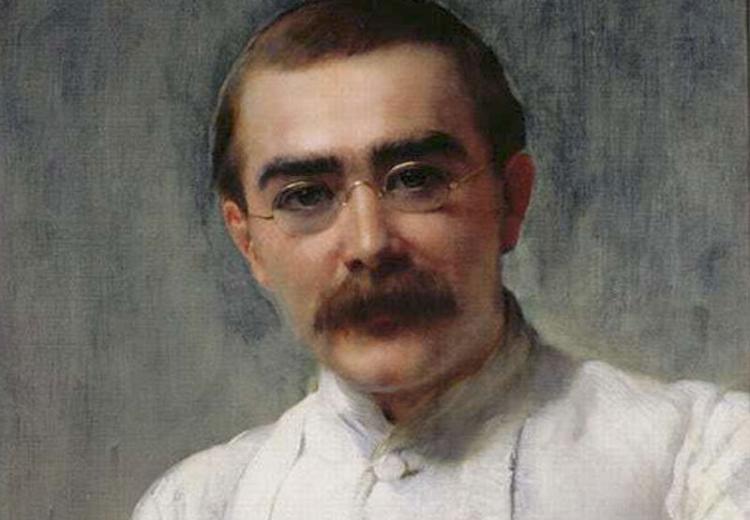

Portrait of Rudyard Kipling.
Credit: Courtesy of Wikipedia, via EDSITEment reviewed Internet Public Library.
During the Victorian Era, British author Rudyard Kipling (1865-1936) was both respected as a journalist and lauded as "The Poet of the [British] Empire." In his fiction, though, he blended the best of both skills and was ultimately awarded the Nobel Prize for Literature in 1907 "in consideration of the power of observation, originality of imagination, virility of ideas, and remarkable talent for narration which characterizes [his] creations." "Rikki-Tikki-Tavi," a short story from The Jungle Book (1894), is an engaging example of Kipling's ability to mix scientific and historical fact with imaginative characterizations to create a believable and entertaining tale.
In this lesson, students will use interactive materials to learn about Rudyard Kipling's life and times, read an illustrated version of "Rikki-Tikki-Tavi," and learn how Kipling effectively uses personification by mixing fact and fiction.
After completing the lessons in this unit, students will be able to:
Rudyard Kipling was born in Bombay, India, in 1865. After receiving his education in England, he returned to India and worked as a journalist, composing and publishing short stories and poetry in his spare time. By 1889, his work had become so popular in Great Britain that he was considered the literary heir of Charles Dickens, though the body of Kipling's works reflected the conflicts and tensions inherent in colonialist instead of domestic social and political policies. Though he received many honors and awards before his death in 1936, he refused all but the 1907 Nobel Prize for Literature, which he was the first Englishman to receive.
The Victorian Era in England began in 1819 when Queen Victoria was born, and ended with her death in 1901 (she was crowned in 1837). Queen Victoria's was an age of invention, industrial expansion, and the indomitable imperialism that gave rise to the quotation, "The sun never sets on the British Empire." It was also a time of cultural flowering: along with Rudyard Kipling, the era welcomed such literary luminaries as Charles Dickens, Lewis Carroll, the Bronte sisters, and Alfred Lord Tennyson.
To begin the lesson, share with your students the story's author and title. Tell them it comes from a collection of short stories called The Jungle Book and have them predict what the story might be about.
As necessary, have your students define a story's setting as the time and place in which the events of a story happen. Then read aloud with your students or have your students read the opening paragraph of the story:
This is the story of the great war that Rikki-tikki-tavi fought single-handed, through the bathrooms of the big bungalow in Segowlee cantonment. Darzee, the tailor-bird, helped him, and Chuchundra, the muskrat, who never comes out into the middle of the floor, but always creeps round by the wall, gave him advice; but Rikki-tikki did the real fighting. He was a mongoose, rather like a little cat in his fur and his tail, but quite like a weasel in his head and his habits.
Have your students identify where the story takes place: the big bungalow in Segowlee (Sagauli) cantonment. Tell your students (or ask them, if they have the appropriate historical background knowledge) that Segowlee cantonment was a British military base in northern India (Bihar province). Have them locate northern India on National Geographic XPeditions's clickable online map or a classroom globe, and explain that Segowlee is located between the cities of Varanasi and Calcutta.
Explain to your students that while the author does not directly state in what year the story takes place, he does tell the reader indirectly when the events happen. Since Segowlee cantonment was a British military base in northern India, the story must take place during a time when the British had military stations in India, when India was a British colony. Have your students explore the interactive timeline from The Victorian Station (available via the EDSITEment reviewed resource The Victorian Web) to discover the name of the first British queen who was also the formal Empress of India (Queen Victoria) and the year in which she received the title (1876).
Note: You may also wish to tell your students that, like the United States of America, India is no longer a British colony. India became independent in 1947.
Next, tell your students that The Jungle Book was published in 1894 and have them put the story's publication in the correct place on the interactive timeline. Guide them to discover the name of the time period (the Victorian Era), and have them summarize the setting of "Rikki-Tikki-Tavi" as it is described in the opening paragraph: a house in northern India during the Victorian Era.
Then have your students read the biography of Rudyard Kipling, available from the Nobel E-Museum, a link from the EDSITEment-reviewed Academy of American Poets, and answer the following questions:
Have your students read the story "Rikki-Tikki-Tavi" from the University of Virginia website, available through the EDSITEment-reviewed Center for Liberal Arts. When they finish, discuss with them the questions below.
1. How does Rikki-Tikki-Tavi help Teddy's family?
Have your students summarize the events of the story individually or in groups by writing, putting story events in chronological order on a timeline, or retelling or acting out the story.
2. Why does Rikki-Tikki-Tavi help Teddy's family? How do you know? Explain which sentences in the story led you to draw your conclusion.
Your students should understand that Rikki-Tikki-Tavi helps Teddy and his family both because the family is kind to him and because, as a mongoose, he instinctively kills snakes. Guide your students to find sentences in the story that show that Rikki-Tikki-Tavi stays with the family because they treat him well and that killing snakes, for which the family is so grateful, comes naturally to him.
3. You have probably heard the phrase, "Actions speak louder than words." Read the following paragraph from "Rikki-Tikki-Tavi":
He spent all that day roaming over the house. He nearly drowned himself in the bath-tubs, put his nose into the ink on a writing-table, and burned it on the end of the big man's cigar, for he climbed up in the big man's lap to see how writing was done. At nightfall he ran into Teddy's nursery to watch how kerosene lamps were lighted, and when Teddy went to bed Rikki-tikki climbed up too; but he was a restless companion, because he had to get up and attend to every noise all through the night, and find out what made it.
What do Rikki-Tikki-Tavi's actions tell the reader about his character? What adjectives best describe Rikki-Tikki-Tavi? Why?
Your students should conclude that because Rikki-Tikki-Tavi spends the day fearlessly exploring his new surroundings, he is curious or bold. Encourage them to find another sentence in the story that supports their conclusion, such as, "It is the hardest thing in the world to frighten a mongoose, because he is eaten up from nose to tail with curiosity."
4. An author usually does not tell the reader that a character is wise, content, or brave. Instead, the author has the character's words and actions show the character's qualities. Read the following paragraph from "Rikki-Tikki-Tavi":
That night at dinner, walking to and fro among the glasses on the table, [Rikki-Tikki] might have stuffed himself with nice things. But he remembered Nag and Nagaina, and though it was very pleasant to be patted and petted by Teddy's mother, and to sit on Teddy's shoulder, his eyes would get red from time to time, and he would go off into his long war cry of "Rikk-tikk-tikki-tikki-tchk!"
What conclusions can you draw about Rikki-Tikki-Tavi from his words and actions?
Your students should understand that while Rikki-Tikki-Tavi enjoys the attention from Teddy's family, he does not lose sight of his goal. Your students might describe Rikki-Tikki-Tavi as determined, responsible, or self-disciplined.
5. Find another place in the story where a character's words or actions show the character's qualities.
You may wish to have your students work together as a class or in small groups to answer this question. If the students work together as a class, you might instruct them to find passages that describe a certain character; if they work in small groups, you might assign a different character to each group.
To extend this activity, you might have each student draw a picture of his or her favorite character in the story and write a paragraph that describes the character, using evidence from the text to support his or her opinion. Have students compare and contrast the conclusions drawn by students who selected the same character, and guide them to understand that one reason why literature is so interesting is because readers can interpret a text differently.
Review with your students that a fact is a piece of information that is true and can be proven. For example, it is a fact that the United States of America and Canada share a border. Fiction, on the other hand, is invented, or made-up, information. Stories about characters that do not exist (such as flying elephants) and events that never happened (such as an alien invasion of Earth) are examples of fiction. As a group, have your students make a list of sources of nonfiction and fiction information. For nonfiction, students might list newspapers, magazines, or encyclopedias; for fiction, they might suggest certain novels, comic books, or movies. Next, tell your students or have them find in the Nobel eMuseum's biography that Rudyard Kipling did both factual writing (as a journalist) and fictional writing (as a poet, short story author, and novelist). Then read the Nobel committee's award description, available through a link from the EDSITEment-reviewed Academy of American Poets, with your students and guide them to understand that the committee members particularly admired Kipling's ability to use facts in his works of fiction. Review with your students that "Rikki-Tikki-Tavi" is a fictional story, because even though there are such things as cobras and mongooses, the story characters and events are made up. Then invite them to separate the facts from the fiction in Kipling's story. First, have your students read an encyclopedia article on mongooses, available through the EDSITEment resource Internet Public Library. Then have them look back through the text to find the examples Kipling included of actual mongoose characteristics and behavior, and record two or more in the appropriate box on the Fact or Personification? chart (PDF). Have them repeat the exercise for the cobra and tailor-bird. If you wish, have students complete the exercise in a large group, or individually or in small groups with a large-group presentation at the end.
Discuss with students the following question: Kipling includes many facts about the animals' appearances and behavior. Do the facts make the story more believable or less believable? Why?
Your students should conclude that the facts make the story more believable. Because Kipling frequently correctly describes the animals' appearances and behavior, their actions, though fictional, seem "real" or "true."
Next, have your students describe the fictional elements in the story they noticed - have them explain what they know was "made up." Share each of the passages below, then ask your students to explain why the passage is an example of fiction.
Animals do not have conversations like human beings do. A mongoose could not have a conversation with a muskrat. To assess students' understanding, you may wish to have your students find one or more other passages in which an animal talks like a human being.
Animals do not try to have their revenge on other animals; vengeance is a human invention. A snake would hunt a bird for food, but it would not seek to kill the bird for revenge. To assess students' understanding, you may wish to have your students find one or more other passages in which an animal thinks or acts like a human being.
Tell your students that giving human qualities to non-human characters (such as animals) is called personification. You may wish to underline the word "person" in personification and emphasize that to personify something is to give it human traits. Explain to your students that to have an animal think or talk like a human being, as exampled in the passages above, is to personify it. Then share with them the following example:
This is the baldest example of personification in the text: though Chuchundra is a muskrat, when he talks, he refers to himself as "a man."
Next, have your students return to the text to find examples of Kipling's use of personification for Rikki-Tikki-Tavi and Nag and Nagaina, and have them record two or more on the Fact or Personification? chart (PDF). If you wish, have them complete the exercise in a large group, or individually or in small groups with a large-group presentation at the end.
When your students finish, discuss with them the following questions:
Your students should conclude that the use of personification makes the story more interesting. Because the characters talk and think like people, the reader can understand and empathize with the characters' motivations. Had Kipling not included the characters' speech and thoughts, the story still would have been interesting, but the reader would not have felt the level of intensity or suspense because he or she would not have been able to understand or empathize with the characters and their struggles.
Have your students discuss the different things they enjoyed about "Rikki-Tikki-Tavi." For example, some students might have liked learning new facts about the animals or setting, others might have appreciated the songs in the story, and still others might have found the characters or plot especially entertaining. You might also want to share your thoughts on the story during their discussion, both to model literature appreciation and to engage your students as a community of readers.
2-3 class periods