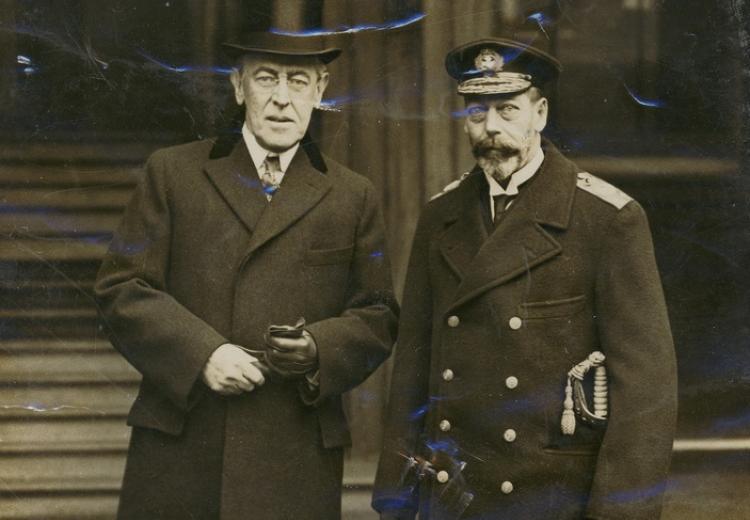

Because of the First World War and its aftermath, Woodrow Wilson fashioned an ambitious international agenda.
Credit: Image courtesy of American Memory at the Library of Congress.
The influence of President Woodrow Wilson on American foreign policy has been profound and lasting. Just before his inauguration, however, Wilson remarked, "[i]t would be the irony of fate if my administration had to deal chiefly with foreign affairs." How did this former professor and Progressive reformer become the architect of an ambitious foreign policy for the United States? Using a variety of primary sources, this lesson analyzes the sources of the foreign policy that came to be known as Wilsonianism and guides students to compare it with important traditions in American foreign policy.
What were the key features of Wilson's foreign policy, and how did it differ from previous American foreign policy?
Foreign policy was not a major issue during the 1912 presidential election, as that year's Democratic Party Platform demonstrated. The high tide of Progressivism was sweeping the nation, and Wilson, as well as his opponents William Howard Taft and Theodore Roosevelt, promised the American people ambitious domestic reforms.
Nevertheless, Wilson's First Inaugural Address offers clues to the principles that would later guide his foreign policy. As Wilson said, "We have built up . . . a great system of government, which has stood through a long age as in many respects a model for those who seek to set liberty upon foundations that will endure." He called for tariff reform, a crucial step toward open markets. Wilson's career as a political scientist and American historian provides additional insight into the formation of Wilsonianism. Wilson believed that the United States, as an exemplar of democratic rule, should promote the spread of democracy. As foreign policy matters began to dominate his attention, Wilson also came to believe that a global organization, or concert, of democratic nations could both spread democracy and prevent non-democratic nations from making war. Without active leadership by the United States, however, such a noble endeavor would fail.
In putting together his foreign policy, Wilson contended with several long-standing trends and principles in U.S. foreign policy. For example, the unilateralism articulated by George Washington in his 1796 Farewell Address still exerted powerful influence. If Wilson was to win public and legislative support for American leadership of a concert of democracies, he needed to rebut the belief that the United States best served its interest by avoiding "entangling alliances." The American System, or Monroe Doctrine, presented another challenge. Would Wilson accept the Roosevelt Corollary and Taft's Dollar Diplomacy, both of which extended the American System in the Western Hemisphere, or would he offer an alternative? The Roosevelt Corollary and Dollar Diplomacy also advanced Progressive Imperialism, as seen in the U.S. assumption of customs collections in the Dominican Republic beginning in 1905 and the sending of U.S. Marines to Nicaragua in 1911. Would Wilson accept without modification his predecessors' justifications for intervention in Latin America?
For definitions of the preceding terms, see the following sites, at the EDSITEment-reviewed resource The American President:
Because this lesson plan focuses on the sources of Wilsonianism and its precedents in American foreign policy, it does not provide comprehensive coverage of major issues such as the Mexican Revolution, World War I, and the League of Nations. For Edsitement lessons on World War I, see United States Entry into World War I: A Documentary Chronology; for the League of Nations, see The Debate in the United States over the League of Nations. This lesson does, however, provide a foundation for subsequent study of these topics in this unit's other lessons. Therefore, the primary sources used here do not require prior classroom treatment of these events.
Students should familiarize themselves with Woodrow Wilson's life, career, and politics, via the EDSITEment-reviewed Internet Public Library:
Students will read the text and view the accompanying photographs and film clips, then answer a series of focused questions designed to guide them to Wilson's views about democracy, the role of government, social and economic reform, and America's place in the world. These questions are available in worksheet form on pages 1-2 of the Text Document.
In the second activity, students will break into sets of two teams, the "traditionalists" and the "innovators." All teams will read the same primary sources, which are grouped into two sets. Each set joins an important Wilson statement on foreign policy to a statement made by a previous President. The traditionalists will look for parallels between the sources, while the innovators will find evidence of what is unique about Wilsonian foreign policy. Excerpts of the following documents have been provided on pages 4-8 of the Text Document, while worksheets to help the students make their lists may be found on pages 9-10. As an aid, all students will receive a one-page handout (located on page 3 of the Text Document) that briefly defines the four main components of Wilsonianism: spreading democracy, open markets, an international organization dedicated to keeping peace, and an active global role for the U.S.
The third activity consists of a debate between the traditionalists and the innovators about this question: "How new was Wilson's foreign policy?" Each side will give two short speeches answering and justifying their answers, followed by two responses from each side. For further guidance, see the Debate Instruction Sheet provided for teachers on page 11 of the Text Document.
Upon completion of the lesson, students should be able to write short (1-2 paragraph) answers to these questions:
Students should be able to define and explain the importance of the following:
Portions of the PBS/American Experience film "Woodrow Wilson" could be shown in class to provide additional information about the influences and events that shaped Wilson's thinking about the world and America's part in it. The short video clips about Wilson's legacy and importance, available at the companion website, could also be shown in class. The companion site also provides a lesson plan on War and Peace.
To trace the influence of Wilsonianism in 20th century U.S. foreign policy, students could select one of the four points of Wilsonianism treated in this lesson (spreading democracy for all nations, open markets, an international organization dedicated to keeping peace, and an active global role for the United States) and write a short essay explaining how Wilsonianism affected a major historical event or U.S. policy. Students could use the following EDSITEment-reviewed web sites to make historical connections for their essays:
Spreading democracy
Open markets
International organization
Active global role for the United States
9-12
2-3 class periods