
Lesson 7: Trekking to Timbuktu: Restoring the Past--Teacher Version
Tools
The Lesson
Introduction
1743 French Map of Northwest Africa, depicting the areas covered in this curriculum unit.
Credit: Courtesy of American Memory at the Library of Congress.
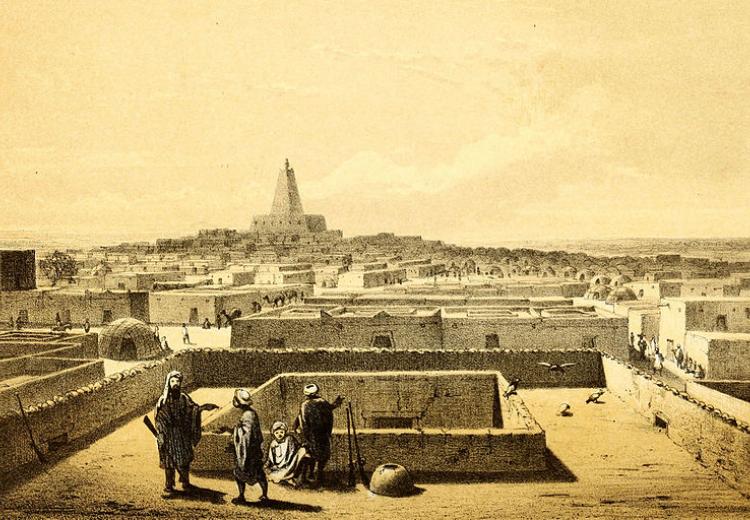
Today, many of the buildings of the ancient city of Timbuktu are crumbing and the streets are covered with blowing sand from the ever-expanding desert. Fragile manuscripts, dating back to days when the city was a major center of Islamic scholarship, are decomposing. But there is hope. Organizations such as UNESCO are mounting campaigns to save the city and restore its ancient heritage.
Guiding Questions
- What environmental factors threaten Timbuktu?
- What measures are being taken to restore the mosques?
- What is the condition of the ancient manuscripts, and what is being done to preserve them?
Learning Objectives
- Describe the environmental conditions that presently threaten Timbuktu
- Explain what efforts are being made to restore the ancient mosques
- Describe the condition of the ancient manuscripts and tell what is being done to preserve them
Preparation Instructions
Read the lesson and bookmark relevant websites. For additional background information access Timbuktu: City of Legends and Ancient Manuscripts, from The Library of Congress.
Lesson Activities
Activity 1. Life in Modern Timbuktu
Since 1960, Timbuktu has been a part of the Republic of Mali. It doesn't look at all like a bustling modern city. See Timbuktu, Mali available through African Studies WWW. And yet, Timbuktu has a thriving economy. As in ancient times, it is an important center of the salt trade, and the long tradition of Islamic scholarship has not yet died.
- Access The Timbuktu Salt Trade. Taoudenni is a site of salt mines in Mali. In early times, larger and more significant salt mines were located in Targhaza, Morocco. Go to Salt of the Earth. Why do you think there is such a huge demand for salt in Mali? Now go to Salt-hauling camel trains. What modern invention is currently threatening the traditional salt trade?
- Read about scholarship in Timbuktu at University of Timbuktu. Scroll down to The Circle of Knowledge: A Contemporary Voice for Traditional Scholars. What roles do the scholars play in modern Timbuktu?
Activity 2. Environmental Hazards
Ancient Timbuktu stood on the edge of the Sahara Desert. Today, the desert sands are constantly creeping further and further south, threatening all that stands in their way.
- Access Deserts and the Sahel available through EDSITEment-reviewed resource Internet Public Library. Scroll down to the third paragraph. Why is the sahel shrinking? Go to Sahel. What crises have been experienced in the sahel in recent years? What strategies are suggested to stop the spread of the deserts? The proximity of sand dunes to the river's edge is shown quite dramatically in Sand dunes east of Timbuktu.
- Go to Neglected and Decaying Sacred Sites. Apart from the shifting sands, what is a major cause of the crumbling of the mosques?
Activity 3. Restoring the Mosques
In response to the threat of encroachment by desert sands, Timbuktu was inscribed on the World Heritage List in Danger in 1990 and UNESCO established a conservation program to safeguard it.
- Access Timbuktu. What three mosques are slated for preservation and restoration?
- Now go to Timbuktu: The Mythical Site. Scroll down to A Town imperiled by sand… ). In what ways has the general population become involved in preserving the buildings? What work needs to be done on the mosques? How successful have restoration efforts been? Now go to Djenne, Mali. Scroll to the final three paragraphs. How does local culture help in the process of preserving ancient buildings in Mali?
Activity 4. Rescuing the Manuscripts
The manuscripts dating back to the 13th century have survived in Timbuktu because of dry heat. But these, too, are in danger of being destroyed.
- Access Threats to the Survival of Timbuktu. Read paragraphs 2, 3, and 4. What aspects of nature threaten the manuscripts. Who was Ahmed Baba? What is the role of the center named after him?
- Now go to Reclaiming the Ancient Manuscripts of Timbuktu. Scroll down halfway to the paragraph that begins "By the beginning." What subjects are treated in the manuscripts? Go to Condition of the Manuscripts. What factors, apart from natural ones, endanger the manuscripts?
- Go to The Road to Timbuktu. Click on Gates Diary. Then, under Related Diary Entries, click on Ancient Manuscripts.
- Now go to Significance of the Manuscripts. In what ways can the ancient manuscripts alter the views Europeans have long held about West Africa? How can recovery and preservation of the manuscripts help to improve the economy of northern Mali? How can tourism help in the efforts to preserve Timbuktu's scholarly past?
- You can view more photos of the manuscripts by accessing Photo of sacred text and Manuscripts
Assessment
Write an impassioned newspaper editorial or letter to the editor about the need to preserve the antiquities of Timbuktu.
Extending The Lesson
Selected EDSITEment Web Sites
The Basics
- Time Required
2 class periods
- Subject Areas
- Authors
- Suzanne Art (AL)
Resources
- Media