
In a letter dated December 5, 1904, to his publisher George Brett, Jack London explains that he wrote White Fang as a companion piece to The Call of the Wild, his famous story about the transformation of a domestic dog into an animal who answers the natural “call” of the wild. He writes, “I’m going to reverse the process. Instead of the devolution or de-civilization of a dog, I’m going to give the evolution, the civilization of a dog—development of domesticity, faithfulness, love, morality, and all the amenities and virtues.”[1] London’s portrayal, however, results in a complication of the fundamental terms “nature” and “culture” in White Fang. Middle school readers of this famous novel, therefore, have the perfect opportunity to become nature and culture detectives. In this lesson, students will explore images from the Klondike and read White Fang closely to learn how to define and differentiate these terms, ultimately presenting their findings as “nature and culture detectives.”
[1]The Letters of Jack London, Vol. 1: 1896-1905. Edited by Earle Labor, Robert C. Leitz, III, and I. Milo Shepard. Stanford, Calif.: Stanford University Press, 1988
How are the concepts of nature and culture defined—and differentiated—in Jack London's White Fang?
Upon completing this lesson, students will be able to
London's intentions to showcase the "development of domesticity, faithfulness, love, morality …" are based on the basic duality of "nature" (the uncivilized wild) vs. "culture" (a domesticated, nurturing environment). After reading White Fang and navigating the book's portrayal of "nature" and "culture," however, one cannot help but to ask: What actually is nature? And what is culture? In fact, one could argue that White Fang is not a reversal of The Call of the Wild—that is, the story of a wolf's civilization—because White Fang never really is transformed from a "natural" state to a domestic, "cultured" state. Instead, as London portrays him, White Fang is born into a state in which even instincts are learned or constructed as opposed to natural or innate.
It is a story's location that often delineates this great nature/culture divide. Featuring London's signature Klondike setting, White Fang, however, introduces a location that actually brings to life questions about the widely accepted duality of nature vs. culture. For throughout the novel, readers visually and imaginatively navigate the borderlands of the Klondike as a place that continually presents both literal divides (e.g., frozen rivers to cross, treacherous mountain passes, lines between fire/heat/light and frozen blackness) and symbolic ones (e.g., the threshold between wild and tame).
The following background resources will help you enter this literary conversation about nature and culture—and the Klondike's place within that divide—giving you a broad view of corresponding issues related to this lesson:
Read "A Baseline Definition of Culture," from the EDSITEment-reviewed Washington State University website. This brief overview of culture suggests what perhaps is the most fundamental and widely accepted element of culture: that "People learn culture." Reading about the "transformation" of White Fang from a wild to domestic state with this definition in mind, students will learn to question fundamental terms such as culture and nature.
Visit the EDSITEment-reviewed PBS site "Nature" to establish a baseline definition of nature and to have resources to show students, if need be, to enhance discussions of nature throughout this lesson. General questions to consider are: What are the elements of nature? What are characteristics and aspects of nature in relation to animals? To humans?
Read the brief biography of Jack London from the The Jack London Collection, a link from the EDSITEment-reviewed website Center for the Liberal Arts. When he was not quite 20 years old, London spent a year prospecting for gold in the Klondike. In fact, he was known for undertaking adventures that he could write about as he explicitly sought to become a great, widely read American writer. London's famous Klondike tale The Call of the Wild (1903), which preceded White Fang, launched and secured his fame. For more Klondike-related biographical information, see Jack London and His Work, a link from The World of Jack London, included in The Jack London Collection.
The following EDSITEment-lessons might be useful both for review and for extending the lesson:
Before students can become nature and culture detectives, they need to develop a basic understanding of the terms "nature" and "culture." First ask students to define these terms, and create on the board a chart of key words that emerge during this discussion.
Use the following guiding questions:
During the discussion, make sure that students understand the basic tenet that people learn culture and that culture is a broad term that may include activities, social elements, beliefs, and products of a given group of people.
Some example keywords might be:
| Nature | Culture |
| Animals | Groups of humans |
| Waterfalls | School |
| Forest | Television |
| Birds | IPods |
| Lightning | Cell phones |
Now lead a discussion about these terms, using the following guiding questions:
Note: At this point, students should begin or be in the process of reading the novel. To help them focus on close reading skills, give them the Close Reading Worksheet and consider discussing the first series of questions as a class activity. As students read the novel throughout, they should complete the worksheet, possibly supplemented by additional entries into a reading journal. A teacher's version of the Close Reading Worksheet (with suggested responses) is also available here.
Introduce White Fang, explaining that Jack London intended to tell the story of a wild wolf that goes through the process of domestication or civilization. Call on students to define the words "domestication" and "civilization" by starting with the root words "domestic" and "civil" or "civilized." Have students add these terms to the nature/culture chart, if they haven't already.
Next explain that London's writing plan means that White Fang would have to change from his wild, natural state to a tame state in which he learns to live among men. Ask students to think of terms related to White Fang that they can add to their chart (Note: at this point students should have read the first two parts of the novel), and add these terms to the board. Revisit this chart throughout each class dedicated to the novel, and add the following terms if they have not yet come up during this initial discussion: hunger, fear, the "Wild," the "Law," learning, tame, mining. Also introduce the following additional vocabulary words for this lesson:
Ask students how to define these words, providing definitions as needed or sending students to a dictionary to look up definitions. Then call on students (either individually or by asking for volunteers) to place these vocabulary words in the appropriate column on the board:
| Nature | Culture |
| Innate | Civilized |
| Instinct | Domestic |
| Savage | Domesticated |
| Pristine | Prospecting |
| Unadulterated |
As your class goes through this process, remind students that while dichotomies are useful for seeing patterns, oftentimes the categories share deep borders and overlap with one another. With this in mind, turn the discussion towards White Fang, using the following questions:
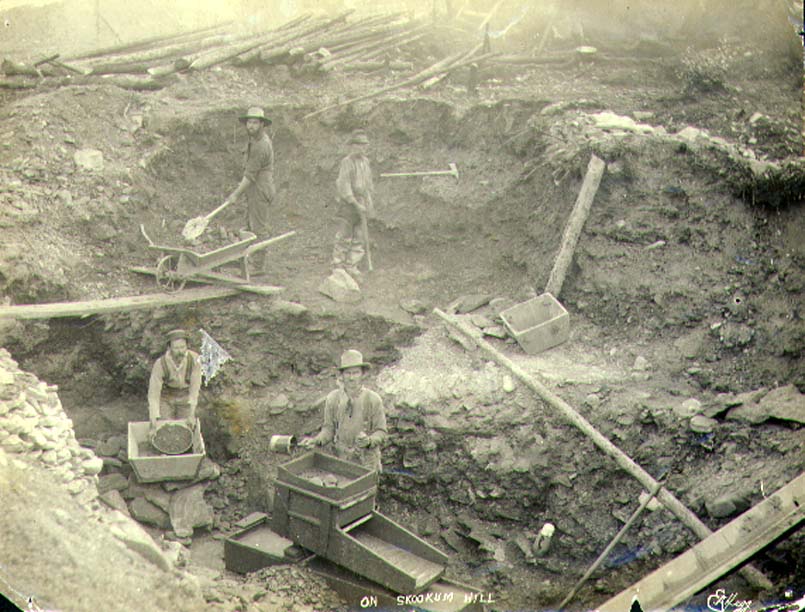
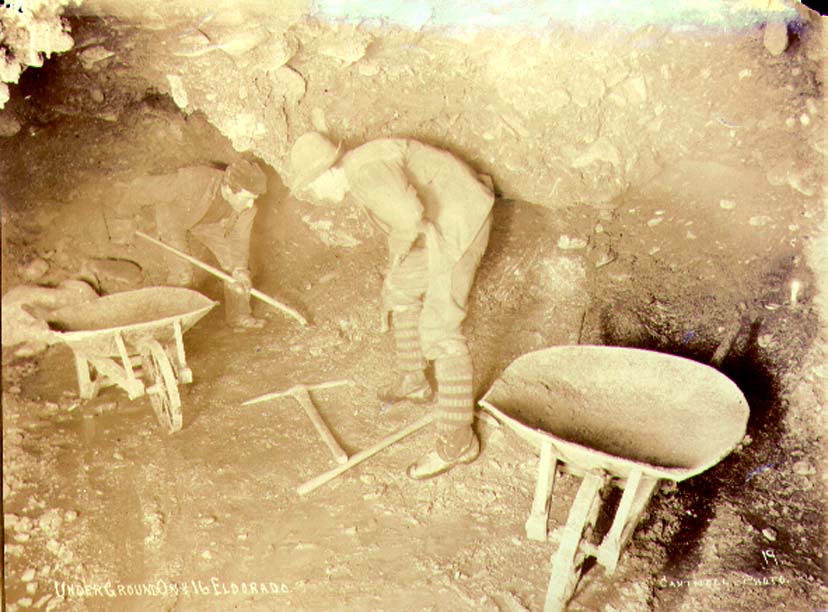
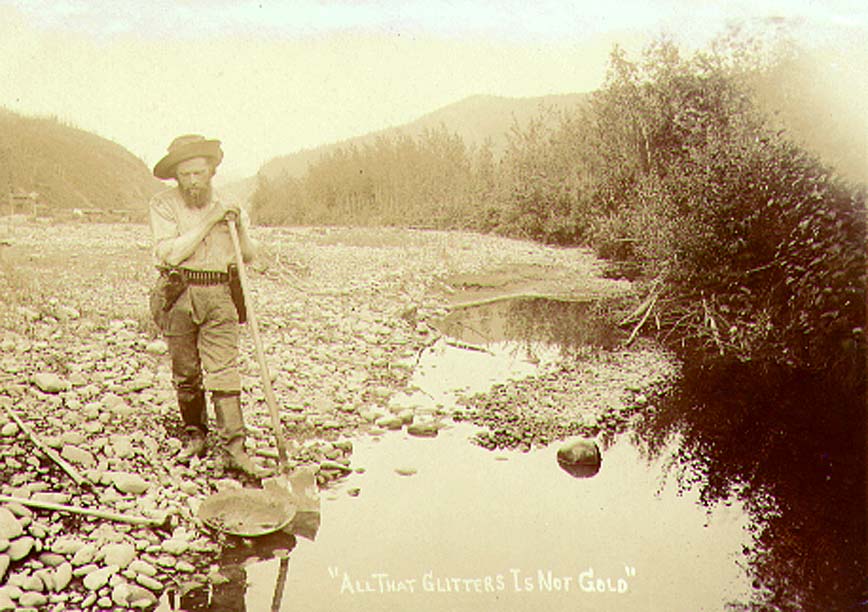
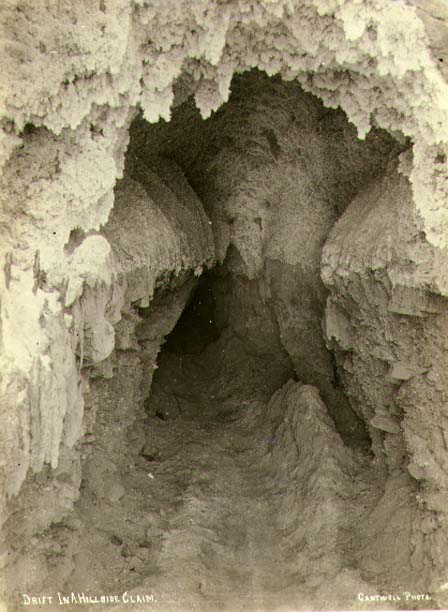
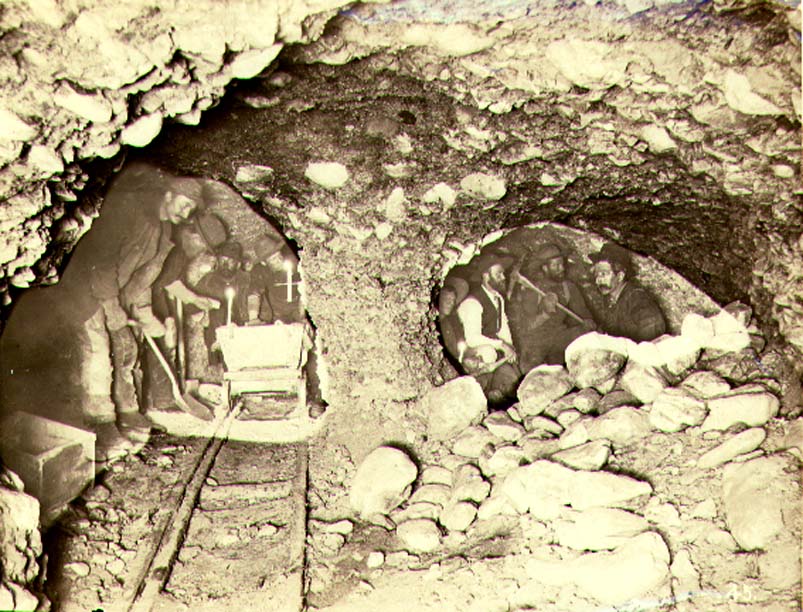
Mention to students that they can learn more about the terms "nature" and "culture"— their differences and their shared borders—by reading and analyzing White Fang in its historical context. Ask students, for example, to think about the word "gold": How would you define and describe gold? Where does gold come from? These questions should lead to a discussion about the difference between gold that hasn't been mined and gold that has been mined, traded, and sold in some form (e.g., bullion, jewelry). Note: this section corresponds to "Gold in Nature and Culture" on the LaunchPad.
Show the following images to enhance this discussion of gold, asking students to describe the images and share what they think is happening in the pictures.
From William E. Meed Photographs, available on the University of Washington Digital Collections:
From Frank La Roche Photographs, available on the University of Washington Digital Collections:
Now ask, "Where on our chart would we place the word "gold"? Students should recognize that gold can be placed in both categories. Ask students the following questions:
Before moving to the next activity, take stock of the basic terms "nature" and "culture." Ask students to elaborate the class discussion that began in the first activity.
Prompt students to recall that "gold" can be both a natural element and an element that has cultural value and cultural characteristics. Now ask students to think about and discuss the word "dog":
Now point out that pop stars weren't the first celebrities to adopt dogs as social symbols. Show students the following images from The Jack London Collection
Ask students the following questions:
Before sending the student groups on their "quest," as described below, discuss the following image following from The World of Jack London, a link from the Jack London Collection: Jack London's cabin. Use the following guiding questions in order to model the group activity below.
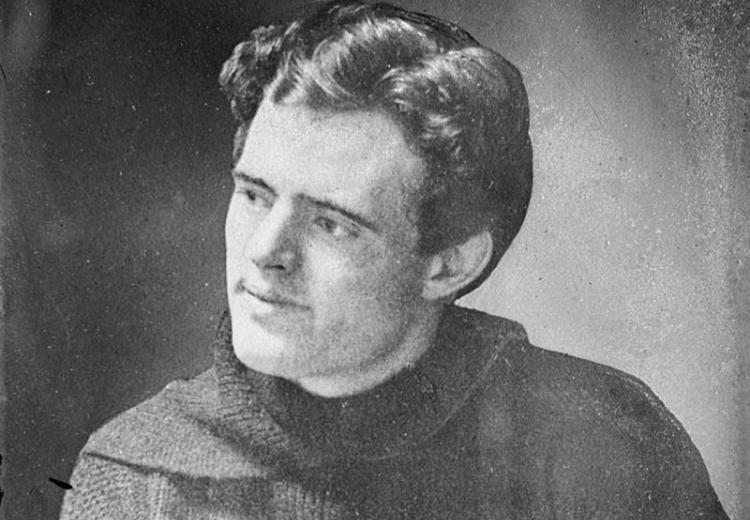
Mention to students that they can look for clues related to nature and clues related to culture in many Klondike images, much like the one of Jack London himself in the Klondike. Divide the class into six groups. Send each group on a quest to discover images from the Klondike that show the relationship between nature and culture. Assign two websites to each group, who can access the sites via the LaunchPad. If need be, small groups can divide and conquer when browsing the websites. If that is the case, assign one website to each group or, alternatively, make half the groups "nature detectives" and the other half "culture detectives." Students can use the Klondike Image Analysis Worksheet to guide their progress.
Encourage them to search using keywords such as Klondike, gold, dogs, etc., and provide students with the following guiding questions:
Give the groups 20 minutes for investigation and analysis. If possible, have students print several of their images for Activity 4, below. If students cannot print the images have them write down the captions and/or titles of the images on individual strips of paper. Direct students to choose two images from their investigation to present to the full class. Have a different person from each group present the image, discussing the full group's findings about nature or culture (depending of the group assignment). Give each group a short period of time to present their two photographs.
By now students should start to experience the difficulty in labeling some of the Klondike images as either an example of only "nature" or "culture." Write on the board "nature" and "culture," and include a thick dividing line between the two terms. If the students were able to print several images from their investigation, challenge each group to place its photos under a label, and ask them to explain their choice. Mention to groups that they can place the photo on the dividing line if they are uncertain where to place the photo, but they should explain how the photo includes elements of both. If students were not able to print the images, have them place the paper strips with the captions or titles of the images. You can start this process by placing a picture of gold nuggets on this dividing line, as well as the Chilkoot Pass photo.
Once all groups have placed their images or captions, lead a discussion about how and why those images stand at the "great divide" between nature and culture, using the following guiding questions:
Using the Chilkoot Pass example, you can point out the this photo shows the prototypical dividing line between the Klondike setting starkly cut by the line of prospectors during their quest for gold. This is a classic image of nature vs. humans.
After students have placed all of the photos, wrap up this image analysis discussion by focusing on how the Klondike setting in particular becomes the borderland between nature and culture. To transition to the text itself, you can end by placing the image of Jack London in the Klondike on the great dividing line. Ask students to explain your action.
Students should have been reading the novel and using the Close Reading Worksheet and/or reading journals to make notes of their thoughts and progress. Reiterate that the Klondike setting is the perfect context for exploring nature and culture. Review the term "setting" as an element of narrative using the definition from "A Glossary of Literary Terms" via the EDSITEment-reviewed Internet Public Library.
With the previous activities in mind, ask students to describe the setting(s) of White Fang, using the following questions:
Then, if students have read The Call of the Wild in class, ask them to describe Buck and recount the general plot. Now ask students to think about White Fang as a character, using the following guiding questions:
Prompt students to consider how White Fang is transformed from a wild wolf into a pet dog:
Turn to the Close Analysis Worksheet, and choose a passage or two to review with the class as a whole. Then have students participate in a Close Analysis Worksheet jigsaw activity by numbering themselves in their investigation groups from Activity 4 (thus, student A is 1, student B is 2, etc.), and then dividing the class into new close analysis groups based on their numbers. Have each group examine at least one passage on the Close Analysis Worksheet and, if time allows, have them search for other relevant passages in the book. Keep in mind that the close analysis groups will include a student from each investigation group. As such, each investigation group representative can share his or her findings in the new close analysis group, thereby working with analysis group members to find commonalities. One student from each group should volunteer to be the note taker. Monitor students as they are discussing the book, and assist them as needed while you circle the room.
There are a number of possible assessment activities:
The following EDSITEment-lessons might be useful for extending the lesson:
3-4 class periods